
Reviewed · HISTORICAL TOURS
Toronto Old Town: Self-Guided Dark History Walking Game
Toronto’s past becomes a citywide puzzle. This self-guided walk turns downtown streets into a 90-minute game, linking major landmarks from City Hall to St. Lawrence Market. I like the freedom to move at your own pace, and I like that the app continues working without Wi-Fi after the first download. The main tradeoff is simple: you get no human guide, so the quality of the experience depends on your group’s interest in solving clues and following directions.
At $8.44 per person, this is an inexpensive way to see a large slice of central Toronto. It works best for friends, families, and couples who want a little structure without committing to a fixed-time walking tour. The history is delivered through short story sections and challenges, rather than through a long explanation from a guide.
In This Review
- Key points to know before you go
- How the self-guided Toronto game works
- Starting at the Toronto sign near City Hall
- Old City Hall and Toronto’s civic story
- The TD Centre and Toronto’s modern power
- Oscar Peterson Place and public art
- The Fairmont Royal York and Toronto’s grand hotel era
- Brookfield Place and the Hockey Hall of Fame
- The King Edward Hotel and early Toronto luxury
- St. James Cathedral and the oldest congregation
- St. Lawrence Hall and public life in 1850
- Finishing at St. Lawrence Market
- Price, pace, and overall value
- Who should choose this experience?
- Should you book the Toronto Old Town dark history game?
- FAQ
- How long does the Toronto Old Town walking game take?
- Where does the game begin?
- Where does the game finish?
- How many puzzles are included?
- Is a guide included?
- Do I need Wi-Fi during the walk?
- Can I cancel for a refund?
Key points to know before you go
- Ten puzzle stops connect Toronto City Hall with St. Lawrence Market, creating a useful route through Old Town and the Financial District.
- The walk takes about 1 hour 30 minutes, though you can pause and resume when convenient.
- The Toronto sign, Old City Hall, the TD Centre, and the Royal York give the route a mix of public spaces, grand architecture, and modern commerce.
- The game is private for your group, so you do not have to match another party’s pace or solve clues in front of strangers.
- The mobile access code and initial download are essential, while Wi-Fi is not needed for the rest of the experience.
- The low price offers good value, but you should choose it for the game format, not for a traditional guided lecture.
How the self-guided Toronto game works
You begin at Toronto City Hall, at 100 Queen Street West. The Questo app then guides you from point to point, giving you a short piece of local history and a puzzle to solve at each location.
The basic rhythm is easy to understand. Arrive at a stop, look around for the required detail, enter your answer, and receive the next location and story. You are not simply walking behind a guide while listening. You are paying attention to signs, buildings, sculptures, and public spaces.
That format gives the route a pleasant sense of purpose. A regular sightseeing walk can blur into a string of facades. Here, you have a reason to examine each place closely. The puzzles also give children and teenagers a task, though younger participants may need help reading the clues or navigating the app.
The experience is offered in English. It is a private activity, meaning only your group participates. That matters if you want to stop for photos, take a break, or let one person in your party work through a clue without feeling rushed by a larger crowd.
The estimated duration is 90 minutes. Treat that as a guide rather than a strict finish time. The game includes the option to pause and resume, which is useful if you want to stop for coffee, lunch, shopping, or a longer look inside an attraction along the way.
More History Tours in Toronto
- Toronto: Dark History Nighttime Walking Tour
★ 4.7 · 273 reviews - Toronto: Distillery District Historic Walking Tour
★ 4.8 · 267 reviews - Toronto Local Beer Tour: 2 Beers at 2 Unique & Historical Pubs
★ 5.0 · 154 reviews
Starting at the Toronto sign near City Hall
The opening stop centers on Toronto’s well-known city sign, installed for the 2015 Pan American Games. It was originally meant to be temporary, with removal planned for no earlier than November 2016, but its popularity led the City of Toronto to keep it.
That small piece of civic history sets the tone for the walk. You are not only looking at famous buildings. You are also noticing how Toronto presents itself, how public art and city symbols can outlast their original purpose, and how a temporary event can leave a permanent mark.
The first puzzle asks you to inspect the area and find an answer. This is a good opening challenge because the location is easy to identify and gives your group a quick test of how the game works.
If you are meeting friends, arrive with the app already downloaded and the access code ready. The game is designed to run without Wi-Fi after the initial download, but you do not want to spend your first few minutes sorting out mobile access beside City Hall.
Old City Hall and Toronto’s civic story
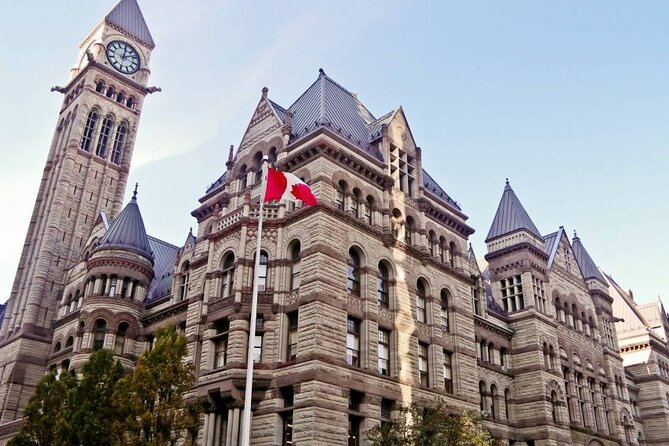
The route next brings you to Old City Hall, completed in 1899. When it opened, it was one of Toronto’s largest buildings and the biggest civic building in North America. It was also Toronto’s third city hall, taking over municipal and court functions from the Adelaide Street Court House.
Old City Hall gives the game a strong architectural anchor. Its size reflects a city growing quickly and gaining confidence. The building was not just an office block. It housed Toronto’s municipal government and the courts serving York County and Toronto.
The puzzle format encourages you to study the building rather than simply photograph it and move on. Look carefully at the details around the site, since the answer may depend on something you could easily miss during a normal walk.
This is also one of the places where a human guide would usually add more background and answer questions. The app provides a shorter, more focused version. If your group wants a full architectural discussion, you may find the content light. If you prefer small portions of history between city walks, the format should suit you.
The TD Centre and Toronto’s modern power
From Old City Hall, the game shifts toward the Financial District and the Toronto-Dominion Centre. The complex includes six towers and a pavilion, all defined by bronze-tinted glass and black painted steel.
The TD Centre is the global headquarters of the Toronto-Dominion Bank and a major office and retail complex. About 21,000 people work there, making it Canada’s largest commercial office complex.
This stop changes the mood of the route. Earlier, you are looking at a monumental civic building from the late nineteenth century. Here, you are surrounded by a modern business center that represents Toronto’s role in Canadian finance.
The challenge asks you to look around the complex for the answer. That makes the open spaces and architectural details part of the game board. You may find this stop particularly interesting if you enjoy modern architecture, city planning, or the contrast between old Toronto and its current business center.
Do not expect a quiet historic setting at every stop. The TD Centre remains a working commercial area, so the experience here is about observing the relationship between public space, office towers, and daily city life.
More Walking Tours in Toronto
- Show me the City! A Small Group Walking Tour of Toronto
★ 5.0 · 621 reviews - Toronto Distillery District Walking Tour
★ 5.0 · 327 reviews - Toronto: City Highlights Walking Tour | 3-Hour
★ 4.6 · 306 reviews - Old Town Toronto Highlights 3 Hour Walking Tour | Gratuity-Based
★ 4.5 · 290 reviews
Oscar Peterson Place and public art
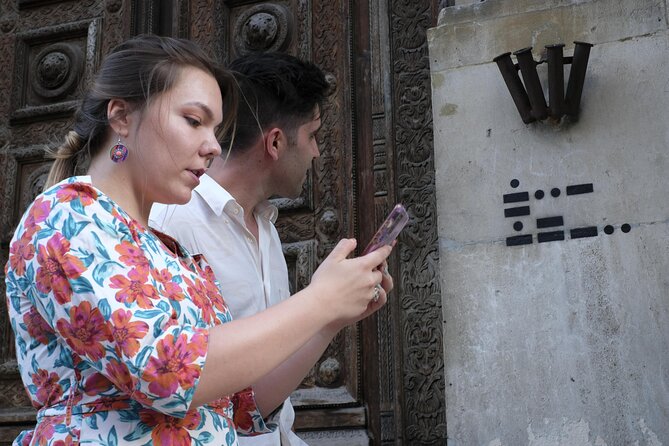
Between the TD Centre towers are two large open areas now known together as Oscar Peterson Place. The northern section contains a more formal granite area. The southern section includes a lawn and The Pasture, a sculpture by Saskatchewan artist Joe Fafard.
This stop gives the route a welcome pause from towers and traffic. It also shows how Toronto’s downtown office districts include spaces meant for people, not only workers moving between buildings.
The sculpture provides a clear target for the puzzle, but the larger value is visual. You get a chance to notice how art, lawn, stone, and office architecture work together in one compact space. The walk does not ask you to visit a museum or buy an admission ticket. Instead, it makes public art part of your route.
If you are playing with a group, this is a natural place to compare answers. The private format means you can discuss the clue openly, though you will still need to agree on the answer before moving forward.
The Fairmont Royal York and Toronto’s grand hotel era
The Fairmont Royal York brings the walk back to the city’s hospitality history. For nearly 90 years, the hotel has hosted royal visitors, heads of state, celebrities, sports stars, and countless other visitors. It has been a key part of Toronto’s luxury hotel story.
The building is especially useful in this game because it connects the city’s railway, business, political, and social worlds. Even if you are not staying there, its presence near the downtown core makes clear how important grand hotels once were, and still are, to a major Canadian city.
The challenge here asks you to examine the location for a detail. You should allow a little time for the scale of the building and its surroundings. This is one of the route’s more recognizable landmarks, so it works well as a mid-walk checkpoint.
The app gives you a story and a puzzle, not a full tour of the hotel. You should not expect access to private areas or a guided interior visit. The point is to connect the hotel’s public role with the wider history of Toronto.
Brookfield Place and the Hockey Hall of Fame
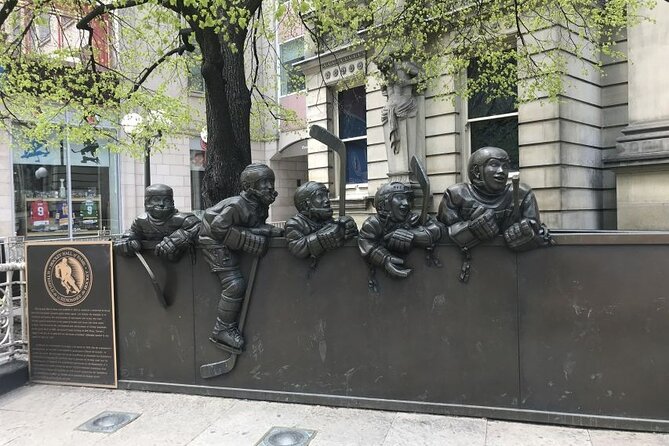
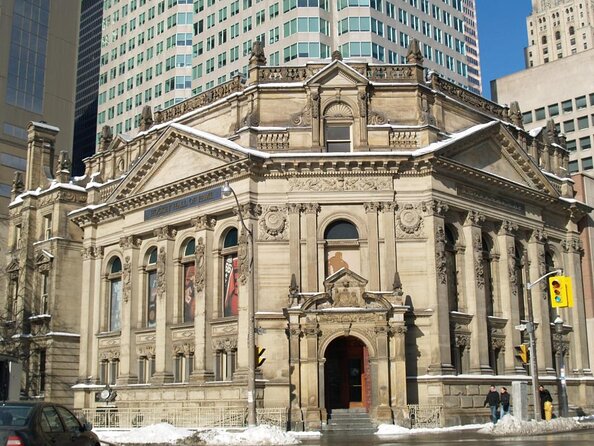
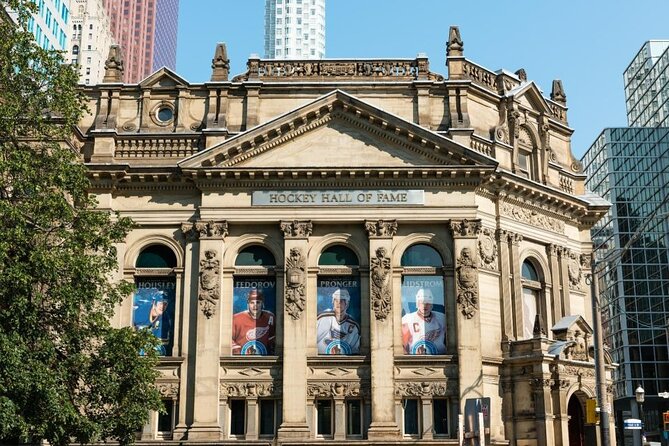
The next section brings you to the Hockey Hall of Fame, now located downtown inside Brookfield Place and a historic Bank of Montreal building. Its first permanent building opened at Exhibition Place in 1961, and the hall moved to its current downtown home in 1993.
The Hockey Hall of Fame has also hosted International Ice Hockey Federation exhibits and the IIHF Hall of Fame since 1998. That gives this stop a clear link to Canada’s favorite sport and to the international side of hockey.
Even if you are not planning to visit the museum, the location adds variety to the walk. The route moves from finance and hotels into sport, national identity, and a building with an earlier banking purpose.
One practical point: this game does not include admission to the Hockey Hall of Fame. The stop is an exterior location in the walking route. If you want to add the museum, plan for extra time and a separate ticket rather than assuming the puzzle includes entry.
The King Edward Hotel and early Toronto luxury
The King Edward Hotel opened in 1903 with 400 rooms and 300 baths. Chicago architect Henry Ives Cobb and Toronto architect E.J. Lennox designed it for developer George Gooderham’s Toronto Hotel Company, and it was named for King Edward VII.
At the time, the hotel claimed to be entirely fireproof. That detail reveals what mattered to hotel builders in the early twentieth century: size, royal associations, modern systems, and reassurance for a public entering a tall, expensive building.
This stop fits the dark-history theme in a broad sense, since old hotels often carry stories of wealth, status, and changing city life. The supplied information does not identify a specific ghost story or crime, so you should not expect a sensational haunted-house presentation. The darker tone comes from the way the game frames old buildings and their past.
The puzzle again asks you to inspect the site. The King Edward is a good place to slow down and consider how Toronto’s hotel culture developed alongside its commercial center.
St. James Cathedral and the oldest congregation
The Cathedral Church of St. James is an Anglican cathedral in downtown Toronto. Its parish was established in 1797, making it the location of the city’s oldest congregation.
This is one of the route’s clearest reminders that Toronto’s history reaches back well before the modern towers nearby. The cathedral gives the walk a religious and community dimension, adding a quieter historical note after the hotels and business buildings.
The challenge is based on looking around the location for an answer. You do not need to follow a guide inside, and the experience does not promise a formal interior visit. If the cathedral is open and you wish to enter, be mindful that it is an active religious place, not simply a sightseeing stop.
For me, this is the sort of location that makes a city puzzle worthwhile. You are not only collecting answers. You are seeing how a city’s oldest institutions remain part of its present-day center.
St. Lawrence Hall and public life in 1850
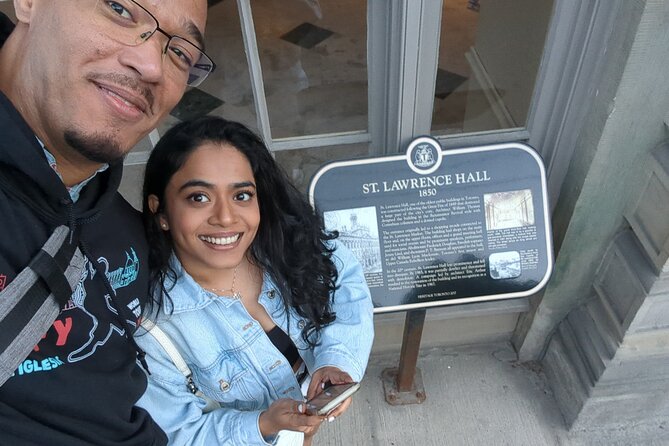
St. Lawrence Hall opened in 1850 as Toronto’s first large meeting hall. Named for Canada’s patron saint, it became a center of cultural and political life, hosting balls, receptions, concerts, exhibitions, and lectures.
This stop helps explain how people gathered before the modern convention center, concert venue, and digital event calendar. The hall was a major stage for public life, and its location near the market connects civic activity with commerce.
The app’s short story gives you a reason to look at the hall as more than another historic facade. The challenge asks you to find a detail at the site, so pay attention to the building and its surroundings before entering an answer.
By this point, the route has covered public administration, finance, hotels, sport, religion, and entertainment. That range is one of the game’s strongest features. You get a broad introduction to Old Town without needing a long lecture at every stop.
Finishing at St. Lawrence Market
The final destination is St. Lawrence Market South, on the southwest corner of Front and Lower Jarvis Streets. It forms part of the St. Lawrence Market complex along with St. Lawrence Market North and St. Lawrence Hall.
Ending here is practical as well as historic. You finish near a major public market, giving you a natural place to eat, browse, or continue exploring after the game. The market also brings the walk back to everyday city life after a route filled with civic landmarks and grand buildings.
The walk ends at St. Lawrence Market, and the app provides step-by-step directions. Follow them closely, especially if you are navigating with a group and stopping to discuss each puzzle.
The market is not included as a food tour or tasting experience. You pay only for the game, so plan separately if you want lunch or time to browse the stalls.
Price, pace, and overall value
At $8.44 per person, this is priced well below most guided city walks. The value comes from combining ten challenges, a clear downtown route, and story content in one low-cost activity.
I would judge the price by your group size and expectations. For two people, it is a modest way to add structure to a city afternoon. For a family or larger private group, discounts may make it even more appealing. You are paying for digital access rather than a guide, transportation, food, or entry to attractions.
The strongest value is flexibility. You can begin any time during the listed operating window, from midnight to 11:30 p.m., and pause when needed. That does not mean every hour is equally pleasant for walking, but it gives you room to fit the game around your plans.
The average booking time is 43 days in advance, which suggests that you should reserve ahead if your schedule is fixed. Confirmation is provided at booking, and free cancellation is available until 24 hours before the start time. Within 24 hours, the payment is not refunded, and changes are not accepted.
Who should choose this experience?
I would choose this walk if you like solving puzzles, exploring independently, and learning history in short sections. It is especially suitable for friends, families, couples, and private groups who enjoy working together.
It also suits repeat visitors who have already seen Toronto’s headline sights but want a reason to connect them in a new order. The route includes famous places, yet the clues encourage you to notice smaller details.
You may want a different option if you prefer a guide who can answer questions, adapt the route, or offer a long narrative about each building. The experience is also not ideal if your group dislikes phone-based activities or gets frustrated when a clue takes time.
Service animals are allowed, the route is near public transportation, and most people can participate. The information does not specify a detailed accessibility assessment for every street or building, so contact the provider if your group needs precise access information.
Should you book the Toronto Old Town dark history game?
Book it if you want a low-cost, flexible city walk with a playful edge. The route covers ten useful stops, the private format keeps the pace in your hands, and the app gives you something to do beyond taking photos.
I especially like the way the walk links the Toronto sign, Old City Hall, financial towers, grand hotels, St. James Cathedral, and St. Lawrence Market. It gives you a clear picture of how Toronto developed from a nineteenth-century civic center into a major modern city.
Skip it if you want a traditional guide, a detailed architectural lecture, or included entry to attractions. But if your group can download the app, follow directions, and enjoy a little friendly debate over answers, $8.44 is a sensible buy.
FAQ
How long does the Toronto Old Town walking game take?
The experience takes approximately 1 hour 30 minutes.
Where does the game begin?
It begins at Toronto City Hall, 100 Queen Street West, Toronto, Ontario.
Where does the game finish?
It ends at St. Lawrence Market in Toronto, Ontario. The Questo app provides step-by-step directions to the market.
How many puzzles are included?
The experience includes 10 puzzle challenges.
Is a guide included?
No. This is a self-guided activity using the Questo app. A physical tour guide is not included.
Do I need Wi-Fi during the walk?
You need to download the experience initially. After that, Wi-Fi is not needed.
Can I cancel for a refund?
Yes. You can cancel at least 24 hours before the start time for a full refund. Cancellations or changes made within 24 hours are not refunded or accepted.
Just added around Toronto
- Toronto Craft Brewery Tour★ 5.0 · 97 reviews
- Canada eSIM | 3-30 days | Daily data | QR code★ 4.0 · 12 reviews
- Handcrafted Donuts of Toronto: A Sweet City Walking Tour★ 5.0 · 141 reviews
- Underground Toronto PATH Tour★ 4.5 · 6 reviews
- Tour to Niagara Falls from Toronto★ 4.0 · 19 reviews
- Customizable Walking Tour of Toronto’s Hidden Gems★ 5.0 · 15 reviews
- Tour to Niagara Falls with skip the line Cruise★ 4.0 · 27 reviews
- Toronto Airport Private Transfer to Downtown★ 4.5 · 10 reviews
Historical Tours, compared.



Evening Gourmet Tour 5 Course Dinner – History and Food in Old Quebec City
Read our review →

Browse the lists this tour appears in