
Reviewed · HISTORICAL TOURS
Sports, Street Skateboarding, Economics, History & Culture
Toronto reveals itself in layers.
This 90-minute downtown walking tour links Nathan Phillips Square, the Financial District, the PATH, Brookfield Place, and Scotiabank Arena through stories about money, movies, hockey, public art, and street skateboarding. I like the unusual mix, especially the way Duncan connects Toronto’s polished towers with its street culture. I also like the personal angle: as a local skateboarder, he brings details that go beyond standard sightseeing.
The main consideration is pace. At $11.22 per person, the price is modest, but you cover several major areas in a short time. You will spend much of the tour listening and walking, rather than entering attractions or lingering for long photo sessions. Good weather is required, and the route ends near the arena, not back at the starting point.
In This Review
- Key points to know before you book
- Nathan Phillips Square sets the tone
- Bay Street brings Toronto’s film and business worlds together
- The PATH explains Toronto below street level
- Toronto’s Financial District, explained without the usual jargon
- Street skateboarding gives the tour its freshest angle
- Brookfield Place mixes grand architecture with hockey control
- Legends Row brings the walk to Maple Leaf Square
- What Duncan does especially well
- What $11.22 gets you
- Who will enjoy this Toronto walk most?
- Practical details that affect your day
- Should you book this Toronto walking tour?
- FAQ
- How long does the tour last?
- Where does the tour begin?
- Where does the tour end?
- What language is the tour offered in?
- What is included in the experience?
- Is gratuity included?
- What happens if the weather is poor?
- Can I cancel for a full refund?
Key points to know before you book
- Toronto through a skateboarder’s eyes: Duncan explains how downtown architecture became a training ground for professional skateboarders and how the city treats street skating today.
- A clever mix of subjects: The route joins Nathan Phillips Square, the PATH, Bay Street, hockey, film locations, finance, public art, and the Raptors.
- A close look at modern city life: You hear how the PATH changed during the pandemic and how its shops and restaurants adapted to hybrid work.
- Useful local recommendations: You receive a Google Map with Duncan’s suggestions for food, drinks, and dessert across Toronto.
- A compact downtown route: The walk begins at 100 Queen Street West and ends at Legends Row outside Scotiabank Arena.
- Small enough for conversation: The group can reach a maximum of 25 people, and Duncan makes room for questions.
Nathan Phillips Square sets the tone
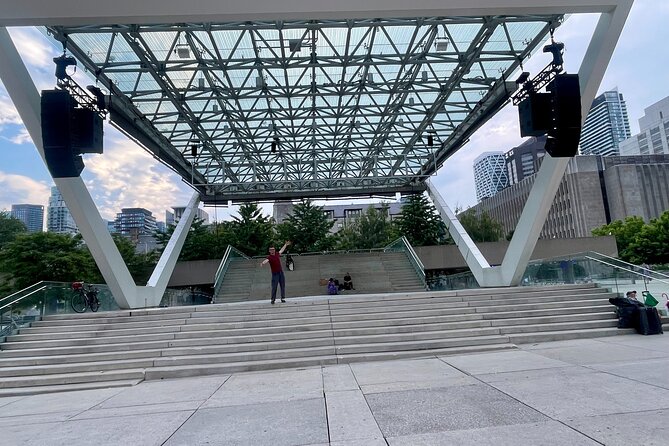
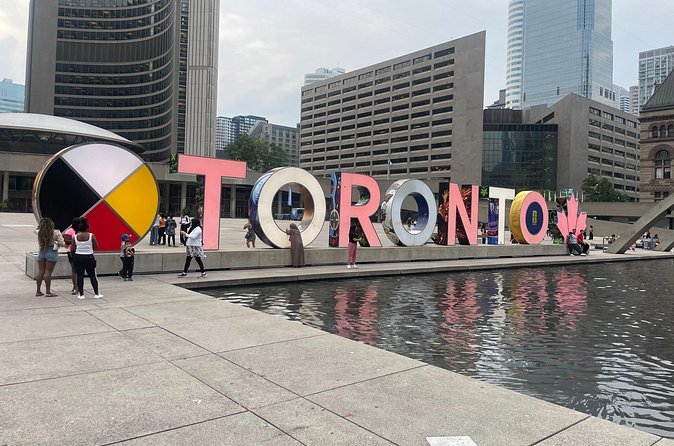
The tour begins at 100 Queen Street West, beside Nathan Phillips Square. This is a good starting point because the square gives you Toronto in one glance: city government, modern architecture, public gatherings, skating, tourism, and civic pride.
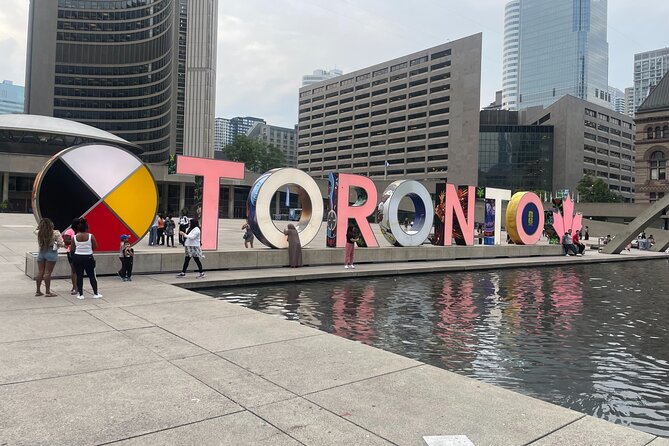
Duncan explains the square’s history and its role in hosting what is described as the largest event in Canadian history. He also points out the famous Toronto Sign by the ice rink, one of the city’s easiest photo stops. The sign is familiar from postcards and social media, but the surrounding stories give the place more meaning than a quick picture and a walk away.
The square also provides a chance to hear about the new Reconciliation Garden nearby. That detail matters because it adds a present-day civic question to the tour. You are not only looking at famous buildings. You are also considering how Toronto uses public space to tell its story now.
I would arrive a few minutes early. The meeting point is central, and the square can be busy with people crossing between Queen Street, City Hall, and nearby transit. The tour is outdoors and weather-dependent, so comfortable shoes and a weather check are sensible.
More History Tours in Toronto
- Toronto: Dark History Nighttime Walking Tour
★ 4.7 · 273 reviews - Toronto: Distillery District Historic Walking Tour
★ 4.8 · 267 reviews - Toronto Local Beer Tour: 2 Beers at 2 Unique & Historical Pubs
★ 5.0 · 154 reviews
Bay Street brings Toronto’s film and business worlds together
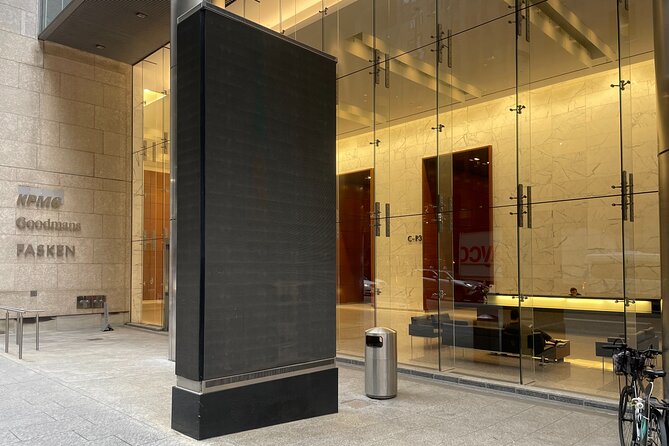
The Bay Street Corridor adds a surprising pop-culture thread. One stop covers the lobby location used in the television show Suits, where Meghan Markle played a paralegal before marrying Prince Harry.
The subject is not limited to celebrity trivia. Duncan discusses Markle’s encounters with the press, fans, and security while filming there. He also covers other productions filmed in the area and the difficulties Toronto’s film industry faces today. That makes the stop useful even if you have never watched Suits. You get a look at how office towers become working film sets, and at the practical tensions between production crews, public space, and everyday city life.
This portion lasts about 10 minutes and requires no admission fee. It is a quick stop, but the change in subject keeps the walk moving. One moment you are considering a financial street, and the next you are looking at it as a television location.
Duncan’s style seems strongest when he explains ordinary places through unexpected stories. He also points out overlooked buildings, fences, and art installations, including details connected with the Law Society building. You may pass these places without a guide and never think to ask why they look the way they do.
The PATH explains Toronto below street level
Part of the tour moves through the Toronto PATH, the underground pedestrian network that links offices, shops, restaurants, transit points, and major downtown buildings.
You learn how the PATH developed, what happened when it closed or saw sharply reduced use during the pandemic, and how its businesses adjusted afterward. The story is really about modern city work. When fewer office employees came downtown every day, businesses that relied on regular foot traffic had to rethink how they operated.
The tour also looks at PATH wayfinding technology. This is a practical subject because the network can feel confusing even when you have a good sense of downtown above ground. Learning how its signs and navigation tools work can help you get your bearings later, especially if you are shopping, trying to reach a restaurant, or escaping bad weather.
Do not expect to walk through every section of the PATH. The tour covers only part of it, and the full network is too large for a short walking route. Still, this segment gives you useful context before you explore more of it on your own.
Toronto’s Financial District, explained without the usual jargon
The Financial District is more than a group of tall office towers. Duncan discusses its development, its importance to Canada’s economy, and the number of people employed there.
That information helps you read the streets differently. You begin to see the district as a daily workplace and economic engine, not just a collection of impressive facades. The route also places Toronto’s business center alongside its creative and recreational uses, from television production to skateboarding.
The subject may appeal most to first-time visitors who want a clearer picture of Toronto’s role in Canada. It can also work well for locals. Several people who grew up in or lived in Toronto for years found that Duncan’s explanations changed familiar streets for them.
One memorable detail concerns the mesmerizing head sculpture from 2020. Duncan uses public art to show how the city’s identity is not confined to financial power and office buildings. Look around as you walk. The tour rewards attention to details you might otherwise ignore.
Still Toronto, at a slower pace:
- Toronto: Niagara Falls Day Tour with Optional Boat Cruise
★ 4.6 · 3,178 reviews - Niagara Falls Day Tour from Toronto
★ 5.0 · 2,889 reviews - Toronto: Casa Loma Entry Ticket
★ 4.7 · 2,705 reviews - Niagara Falls Canada Day Tour From Toronto + Boat Cruise Option
★ 5.0 · 2,576 reviews
Street skateboarding gives the tour its freshest angle
This is the part that makes the experience different from a standard downtown history walk.
Duncan explains the history and development of street skateboarding in central Toronto. He describes how professional skateboarders began filming tricks on the city’s urban architecture and how those spaces helped launch careers. Concrete ledges, steps, rails, and plazas take on a second purpose when you see them through a skater’s eyes.
You also hear about the current climate for street skateboarding downtown. That adds a useful tension. Public architecture can be designed for movement and gathering, but city authorities and property owners may not always welcome the way skaters use it. The tour presents downtown as a place negotiated by office workers, residents, visitors, businesses, artists, and skaters.
I especially like this lens because it connects sport with design. You are not simply hearing sports facts. You are learning how young people read a city, how certain spaces become known in skate culture, and how public behavior can shape debates about shared space.
If you have no interest in skateboarding, you should still find this section worthwhile. It explains a side of Toronto that most conventional tours skip. If you already skate, or follow professional skateboarding, this may be the strongest reason to book.
Brookfield Place mixes grand architecture with hockey control
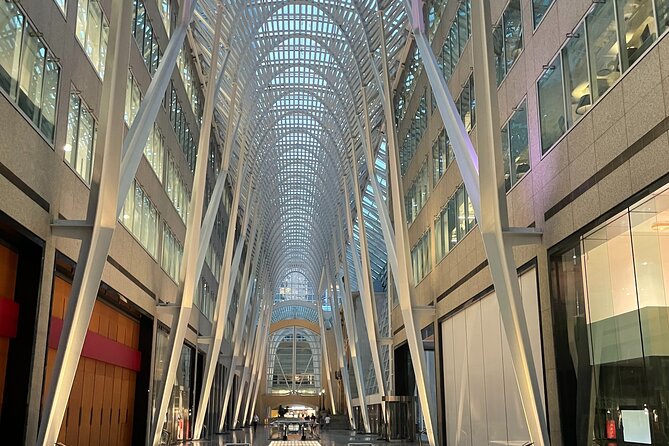
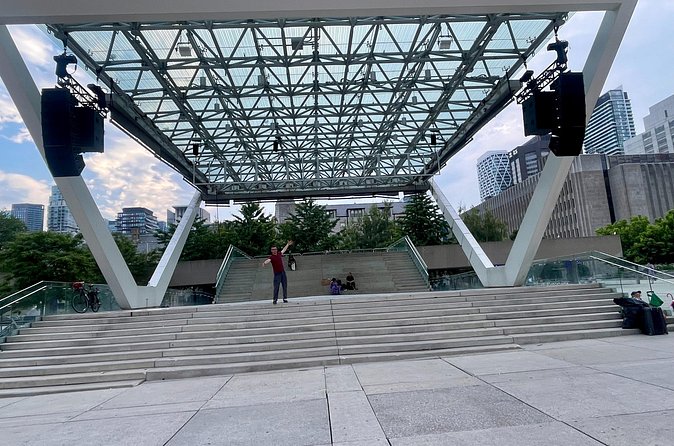
Brookfield Place is the tour’s main extended stop, with about 20 minutes devoted to its history and architecture.
The complex offers a useful contrast to the open civic space at Nathan Phillips Square. Here, the focus shifts toward office towers, interior design, commercial activity, and the way older and newer architecture can meet in one downtown setting.
The tour also explains the NHL Situation Room, located in the southwest tower. This is where the National Hockey League handles important game-related decisions and reviews. It is a small but fascinating link between a Toronto building and hockey played across the league.
You do not pay admission for the stop, and the experience is primarily an outdoor and walking presentation. The value comes from Duncan’s explanation, not from entering a paid attraction. That is worth keeping in mind if you expect a museum-style visit.
Brookfield Place is also a useful place to pause and look up. The architecture makes more sense when someone explains its purpose and background. Duncan’s approach, based on stories and visible details, helps keep the information grounded in what you can actually see.
Legends Row brings the walk to Maple Leaf Square
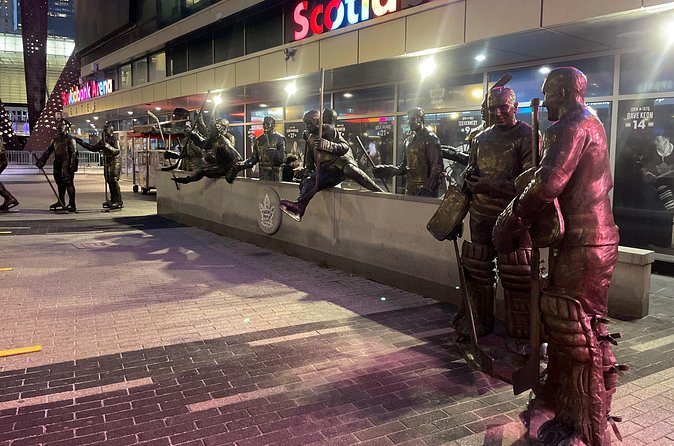
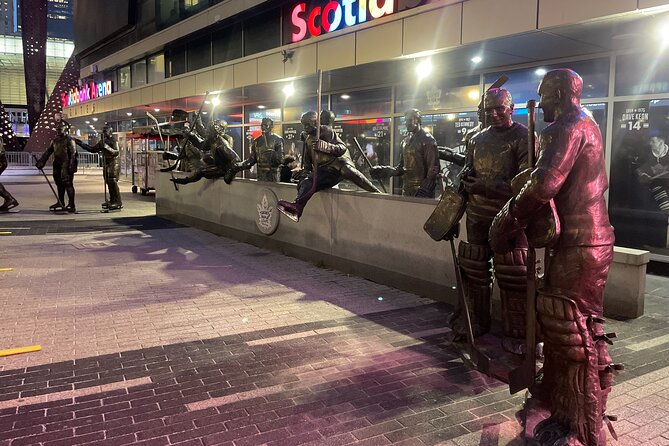
The tour ends at Legends Row outside Scotiabank Arena, on Raptors Way. The sculpture honors former Toronto Maple Leafs players and gives the final section a strong local-sports focus.
Duncan explains the artist behind Legends Row and the history represented by the sculptures. The stop is not just about statues. It is about how Toronto celebrates sports figures and how hockey fits into the city’s identity.
The route then shifts to the Toronto Raptors. You hear about the team’s acquisition of NBA star Kawhi Leonard, the 2019 NBA Finals victory, and the renaming of Bremner Street to Raptors Way. Duncan also addresses the challenge the Raptors face when trying to attract and sign top NBA talent as the only Canadian team in the league.
This ending works well because it leaves you near a major sports venue and a recognizable public gathering place. If you plan to attend an event at Scotiabank Arena, the tour can help you arrive with more context. If not, you are close to Maple Leaf Square and the PATH, with the rest of downtown within easy reach.
Remember that the end point is not the starting point. You should plan your next stop from the arena area rather than assuming you will return to City Hall.
What Duncan does especially well
Duncan receives strong praise for being friendly, easy to understand, and open to questions. That matters on a tour with this many subjects. Finance, architecture, film, hockey, and skateboarding could feel disconnected, but his personal stories tie them together.
His strongest quality is local perspective. He shares anecdotes from growing up in Toronto and brings first-hand interest in the city’s street life. The tour also reveals places that even long-time residents may never have visited or noticed.
I would expect the experience to feel conversational rather than formal. That is a plus if you like asking questions or learning through stories. It may be less suitable if you prefer a tightly scripted lecture with dates, names, and long historical explanations at every stop.
The group limit of 25 keeps the size manageable. It is not a private tour, but it is small enough that you should have a reasonable chance to hear the guide and ask something along the way.
What $11.22 gets you
At $11.22 per person, this is unusually inexpensive for a 90-minute guided walk through central Toronto. You are paying for interpretation and local insight rather than entry tickets, transportation, or a long list of included attractions.
The value is particularly good if you plan to explore downtown independently afterward. The guide helps you understand the PATH, the Financial District, Brookfield Place, the arena district, public art, and street architecture. You also receive a Google Map of Duncan’s Toronto recommendations for food, drinks, and dessert.
That map may be worth more than it first appears. Dining advice is most helpful when it comes from someone who lives with the city rather than someone repeating a short list of famous places. I would save the map and use it to plan a meal or treat after the walk.
There are limits. Food and drinks are not included, and gratuity is separate. The tour does not provide admission to attractions, and there is no promise of a private group. Even so, the low price leaves room in your budget for lunch, coffee, or dessert afterward.
Who will enjoy this Toronto walk most?
I would recommend it to first-time visitors who want an introduction to downtown that goes beyond the main landmarks. The route gives you basic civic, economic, cultural, and sports context in a single outing.
It is also a good choice for locals who think they already know the core. The personal stories, public art, PATH details, and skateboarding history can make familiar streets feel new.
Sports fans should pay special attention to the hockey and Raptors sections. Film and television fans will appreciate the Suits location and the discussion of Toronto’s film industry. People interested in city planning or public space will get the most from the PATH, Financial District, and skateboarding sections.
I would be more cautious if you have limited mobility or dislike walking outdoors, since the experience is a walking tour and requires good weather. Service animals are allowed, and most people can participate, but the supplied details do not specify the exact distance, number of stairs, or seating opportunities.
Practical details that affect your day
The tour is offered in English and uses a mobile ticket. Confirmation arrives when you book. It operates near public transportation, which helps at both ends of the route.
The starting address is 100 Queen Street West, Toronto, Ontario M5H 2N2. The walk finishes at Legends Row, at 19 The PATH, Maple Leaf Square, Toronto, Ontario M5J 2J8, outside Scotiabank Arena on Raptors Way.
The average booking time is 13 days in advance, so I would not assume you can always arrange it at the last minute. The maximum group size is 25 people.
You can cancel for a full refund up to 24 hours before the start time. Changes or cancellations made inside that period are not accepted for a refund. If poor weather cancels the tour, you can choose another date or receive a full refund. The same applies if the minimum number of participants is not reached.
Should you book this Toronto walking tour?
I would book it if you want a compact, affordable introduction to downtown with a strong local voice. The best features are Duncan’s personal stories, the street-skateboarding angle, the practical look at the PATH, and the way the route links Toronto’s economic center with its sports and film culture.
I would skip it only if you want indoor attractions, a slow pace, or a tour focused on one subject alone. For everyone else, $11.22 buys a useful orientation, several unusual stories, and a restaurant map you can keep using after the walk ends.
FAQ
How long does the tour last?
The tour lasts approximately 1 hour and 30 minutes.
Where does the tour begin?
It begins at 100 Queen Street West, Toronto, Ontario M5H 2N2, Canada.
Where does the tour end?
It ends at Legends Row outside Scotiabank Arena, on Raptors Way near Maple Leaf Square. The listed end address is 19 The PATH, Maple Leaf Square, Toronto, Ontario M5J 2J8.
What language is the tour offered in?
The tour is offered in English.
What is included in the experience?
You receive a Google Map with Duncan’s recommendations for Toronto food, drinks, and dessert. He also provides travel advice and recommendations at the end of the tour.
Is gratuity included?
No. Gratuity or a tip is not included.
What happens if the weather is poor?
The experience requires good weather. If it is canceled because of poor weather, you will be offered another date or a full refund.
Can I cancel for a full refund?
Yes. You can cancel at least 24 hours before the experience start time for a full refund. Cancellations or changes made less than 24 hours before the start time are not accepted for a refund.
Just added around Toronto
- Toronto Craft Brewery Tour★ 5.0 · 97 reviews
- Canada eSIM | 3-30 days | Daily data | QR code★ 4.0 · 12 reviews
- Handcrafted Donuts of Toronto: A Sweet City Walking Tour★ 5.0 · 141 reviews
- Underground Toronto PATH Tour★ 4.5 · 6 reviews
- Tour to Niagara Falls with skip the line Cruise★ 4.0 · 27 reviews
- Tour to Niagara Falls from Toronto★ 4.0 · 19 reviews
- Customizable Walking Tour of Toronto’s Hidden Gems★ 5.0 · 15 reviews
- Toronto Airport Private Transfer to Downtown★ 4.5 · 10 reviews
Historical Tours, compared.



Evening Gourmet Tour 5 Course Dinner – History and Food in Old Quebec City
Read our review →
Browse the lists this tour appears in