
Reviewed · TORONTO TOURS
Toronto Essentials Tour: Old Town & Downtown Highlights (PWYC)
Toronto’s best stories are hiding in plain sight. This pay-what-you-choose walking tour links Union Station, the PATH, Old Toronto, the financial district, and City Hall in one useful route. I like the sharp contrast between the grand old bank buildings and futuristic modern architecture. I also like the practical ending at Nathan Phillips Square, where you can continue sightseeing on your own. The main consideration is timing: the route is described as roughly 90 minutes to two hours, so expect a brisk overview rather than a slow, detailed look at every stop.
The guides bring different strengths. Michael, a recently retired history teacher, is praised for his lively delivery, while Ulysses focuses on architecture and Aaron is especially helpful with follow-up tips. The group can reach 30 people, and the tour leaves on time, so arriving early at the exact Union Station meeting spot matters.
In This Review
- Key points to know before you book
- Why this short Toronto walk works
- Finding the guide inside Union Station
- The CN Tower and Toronto’s railway story
- Brookfield Place and the PATH underground
- Hockey, the market, and useful follow-up tips
- Berczy Park and the famous dog fountain
- St. James Cathedral and Old Toronto
- The financial district and Toronto’s stone cathedrals
- City Hall and Nathan Phillips Square
- Guides, group size, and the walking pace
- Who should book this Toronto tour?
- Should you book it?
- FAQ
- How much does the Toronto Essentials Tour cost?
- How long does the tour last?
- Where does the tour begin?
- Where exactly inside Union Station should I meet the guide?
- What time does the tour start?
- Where does the tour finish?
- Is the tour offered in English?
- Does the tour visit the inside of the Royal York Hotel?
- Does the tour include a visit to the hockey attraction?
- Can I cancel for a full refund?
- How large can the group be?
- Are service animals allowed?
Key points to know before you book
- Meet inside Union Station’s Great Hall: Look for the guide near the information booth beneath the central clock, not outside or in the food court.
- See Toronto’s major contrasts: The route moves from the Royal York Hotel and St. James Cathedral to Brookfield Place and the modern City Hall.
- Walk part of the PATH: You get an introduction to Toronto’s underground network, but you must stay close to the guide.
- Enjoy strong CN Tower views: The tower appears early, giving you an immediate sense of Toronto’s scale.
- Finish at Nathan Phillips Square: The tour ends beside City Hall and the famous TORONTO sign, near public washrooms and future sightseeing.
- Pay very little for a lot of context: At about $4.50 per person, this is excellent value if you want orientation more than a deep historical study.
Why this short Toronto walk works
Toronto can feel spread out when you first arrive. Its main sights are close enough to connect on foot, yet the streets, office towers, transit passages, and old neighborhoods do not always explain themselves. This tour gives you a basic map of the downtown core while adding the stories that make the buildings easier to notice later.
The route begins at Union Station and ends at City Hall. That direction makes sense. You start with Toronto’s rail past, move through the financial center and Old Town, then finish with the city’s modern civic identity. Along the way, you see how railways, banks, religion, sports, public art, and government shaped Toronto.
At $4.50 per person, the value is unusually strong. This is not a costly sightseeing package with admissions or transport included. You are paying for an English-speaking guide who supplies context while you walk. Since the stops are viewed from public areas and no admission tickets are included, the price works best for a first look at the city.
The tradeoff is depth. You will not get a long interior visit at every building. The tour is designed to help you understand where you are and what deserves a return visit.
A few more Toronto trips worth comparing
- Toronto: Niagara Falls Day Tour with Optional Boat Cruise
★ 4.6 · 3,178 reviews - Niagara Falls Day Tour from Toronto
★ 5.0 · 2,889 reviews - Toronto: Casa Loma Entry Ticket
★ 4.7 · 2,705 reviews
Finding the guide inside Union Station
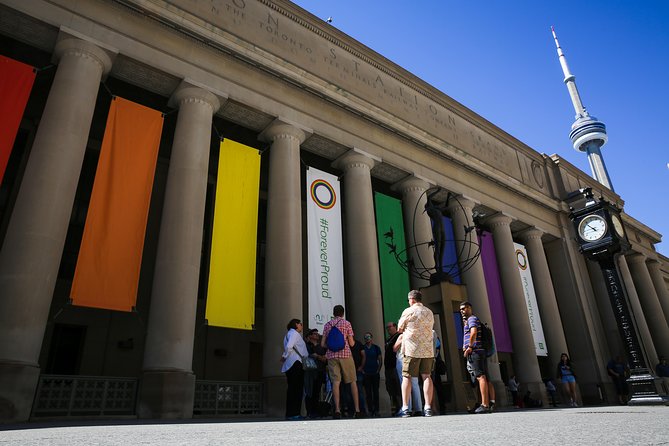
The meeting point is the first practical challenge. Union Station is large, and several places can look like the right location. You need the Great Hall, which is inside the station and accessible from Front Street.
Look for a high-ceilinged room with large windows on both sides. Flags hang along one wall. An information booth sits beneath a clock in the middle of the room, and the names of cities served by the station’s railway network circle the interior. That combination of room, clock, and booth is your clue.
Do not wait by the large clock outside. Do not head for the separate tourist information center or the food court. Your guide should be near the information booth in the Great Hall.
The tour starts at 10:00 a.m. and leaves on time. If you arrive late, the guide cannot wait. I would arrive with enough time to locate the Great Hall, especially if this is your first visit to Union Station.
The CN Tower and Toronto’s railway story
One of the first memorable sights is the CN Tower. Your guide uses it to explain Toronto’s ambitions and practical needs. The tower helped improve television and radio reception in the region in the 1970s, while its great height created the skyline image that Toronto still uses to represent itself.
The CN Tower was once the tallest free-standing structure in the world. It has since been surpassed by Dubai’s Burj Khalifa, but the tower remains an important symbol of Toronto. From the walking route, you get views from useful city vantage points without needing to buy an observation ticket.
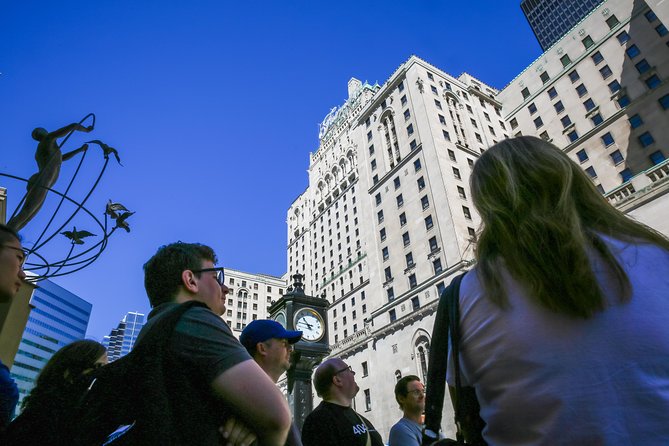
The tour then turns to the Fairmont Royal York Hotel, across from Union Station. When Canada’s railway companies built their lines, they also built grand hotels near major stations. These hotels helped persuade wealthy passengers to make the long trip across the country by train.
Toronto’s Royal York opened in 1929, just as the world economy was heading toward collapse. It survived the Great Depression and competition from newer hotels, becoming a beloved local landmark. Tour groups are no longer allowed into the lobby, so this part of the tour is an exterior view. That limitation matters if you hoped to see the interior, but the outside still fits neatly into the railway story.
Brookfield Place and the PATH underground
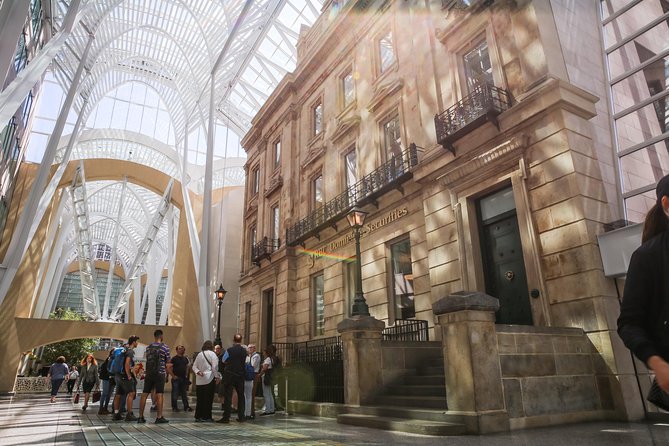
Brookfield Place is one of the most striking architectural stops. Santiago Calatrava designed the public space, where white steel ribs and tall glass create a bright, high vaulted interior. It feels very different from the heavy stone and formal lines of the older buildings nearby.
The building also introduces Toronto’s PATH network. PATH is a system of underground corridors, food courts, and connections linking downtown buildings with nearby subway stations. It is useful in bad weather and handy for office workers, but it can be confusing at first.
Your guide walks part of the network and explains how it developed. Stay close. The PATH is not a place to wander off while admiring storefronts, because one corridor can lead to another before you realize you have lost the group. This is a short sample, not a full underground expedition, and that is sensible for a compact tour.
The PATH section adds real practical value. You learn not only what the system is, but also why Toronto’s downtown operates on two levels. Above ground, you see streets and towers. Below ground, you find a second network of routes and services.
Still Toronto, at a slower pace:
- Niagara Falls Canada Day Tour From Toronto + Boat Cruise Option
★ 5.0 · 2,576 reviews - Toronto: Harbor and Islands Sightseeing Cruise
★ 4.7 · 2,566 reviews - Toronto: City Sightseeing Hop-On Hop-Off Bus Tour
★ 4.3 · 2,544 reviews - Niagara Falls from Toronto: Skip-the-Line Boat & Skylon Tower
★ 5.0 · 2,406 reviews
Hockey, the market, and useful follow-up tips
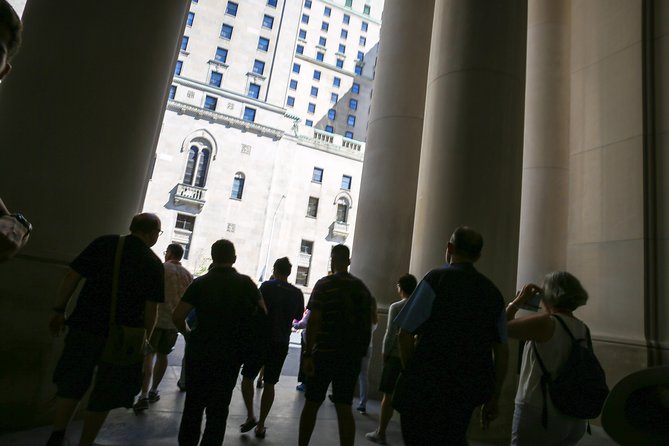
Hockey receives a brief mention, with a pointer toward the Stanley Cup trophy and a difficult-to-find attraction entrance. The tour does not include a full visit, but the guide helps you know where to return if hockey interests you.
This is a good example of the tour’s limits and strengths. You do not spend time inside the attraction, so hockey fans seeking a full museum or trophy experience need another plan. But you do get a useful orientation and some local humor about the Toronto Maple Leafs and their long struggle to win another Stanley Cup.
The route also gives you advice for visiting the market after the tour. The market itself is not presented as a long stop here, but the guide explains its role in Toronto’s development and offers pointers for a later visit. That can be helpful if you want to continue exploring rather than finish sightseeing at City Hall.
Aaron, one of the guides praised for clear communication, is noted for offering extra tips after the walk. That kind of practical advice can make a short orientation tour more useful, especially when you still have several days in Toronto.
Berczy Park and the famous dog fountain
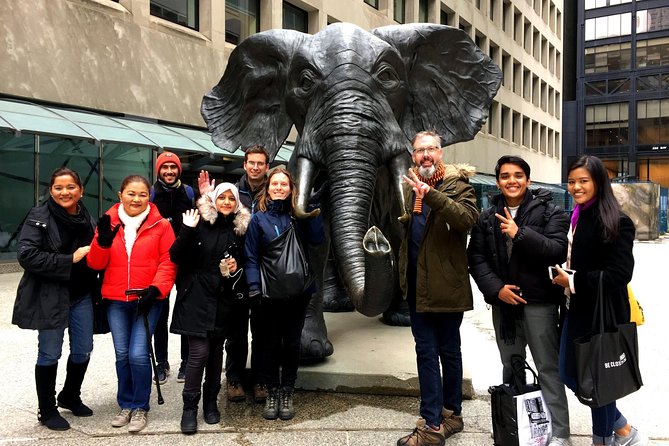
Berczy Park is a small but memorable stop. Its famous dog fountain features a row of dogs sending water into the air. The guide explains why Toronto has public art of this playful sort.
You will spend about five minutes here, so do not expect a long art lecture. The value is in seeing how the city uses small public spaces and humor to make the downtown area more human. It also gives you a photo stop between the larger architectural sights.
Because the tour moves at a steady pace, keep your camera ready. Short stops can pass quickly, especially with a group.
St. James Cathedral and Old Toronto
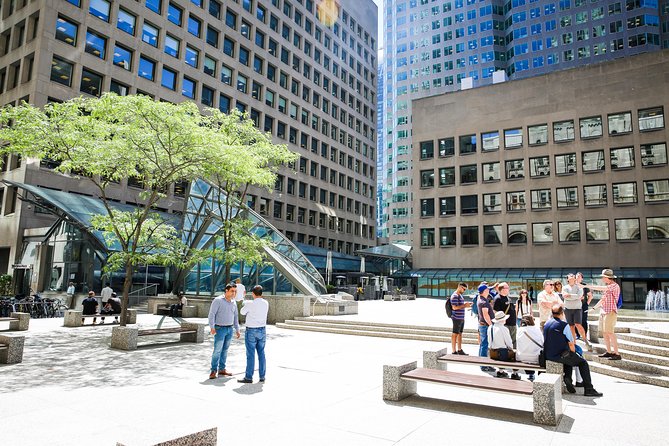
The Cathedral Church of St. James brings the tour into the older religious and political center of Toronto. This Gothic Revival building was the spiritual heart of Old Toronto and a place where religion and civic power met in the 19th century.
The guide connects the cathedral with the early city, once known by the less flattering nickname Muddy York. That contrast helps explain why Toronto’s old core can feel unlike the newer downtown blocks only a few minutes away.
This stop is especially strong for anyone interested in architecture. Ulysses has been praised for pointing out details people might otherwise miss, and this is the sort of place where a guide can improve your view. You may see the building as a church at first. With explanation, it also becomes evidence of how the city organized power and public life.
The tour does not promise a lengthy interior visit, so check your expectations. You are getting context and an exterior look within a larger route.
The financial district and Toronto’s stone cathedrals
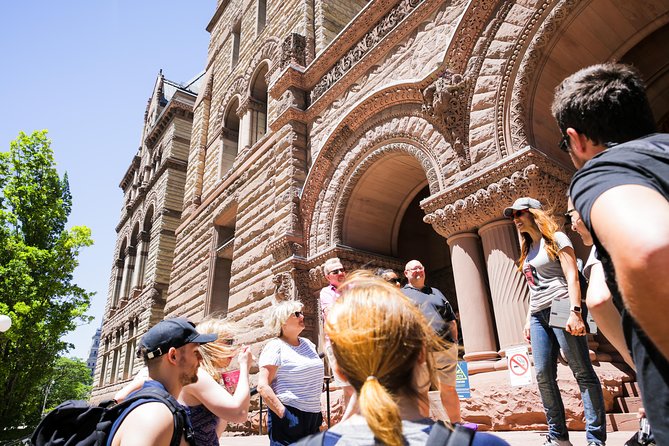
The financial district is one of the tour’s best stretches. You walk among Canada’s largest skyscrapers and hear about the major Canadian banks, the 1904 Great Fire, and the daily world of buying and selling.
The older bank buildings are a highlight. Their formal stone facades and grand interiors can feel more like churches than offices. One guide described them as cathedrals, and that is a useful way to look at them. They were built to project stability, wealth, and confidence.
The Great Fire of 1904 adds a human detail to the district’s polished appearance. The fire caused serious damage, and the tour mentions John Croft, whose connection to the event gives the story a personal angle rather than leaving it as a dry date.
This section takes about 15 minutes and provides a good sense of Toronto as Canada’s financial center. You will not become an expert in the banks or the stock market, but you will understand why the towers are here and why the older buildings matter.
City Hall and Nathan Phillips Square
The final stop is Toronto City Hall, completed in 1965. Its futuristic design signals a city eager to present itself as modern, important, and forward-looking. The building also reflects Toronto’s affection for concrete, a point the guides treat with a light touch.
In front of City Hall, Nathan Phillips Square provides a large public gathering place. It hosts New Year’s Eve celebrations, farmers markets, protests, and other civic events. The square is a useful ending because it shows Toronto not only as a collection of offices and landmarks, but also as a place where residents gather and make their voices heard.
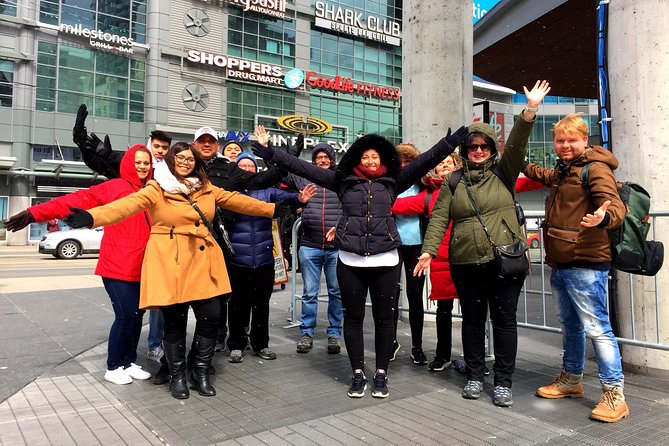
The TORONTO sign sits out front, making this the obvious spot for a group photo or selfie. Public washrooms are nearby, another small but useful detail at the end of a walking route.
The contrast with Old City Hall is one of the tour’s central ideas. The older building represents an earlier Toronto, with more traditional civic architecture. The 1965 City Hall looks toward the future. Seeing both helps you understand the city’s changing self-image.
Guides, group size, and the walking pace
The tour is offered in English and can include up to 30 people. That is large enough to create a lively group but small enough for a guide to manage at city stops. A group of 30 can still make narrow sidewalks and underground corridors feel crowded, so staying together is important.
The guides bring different styles. Michael, a recently retired history teacher, is praised for combining solid information with humor and enthusiasm. That approach suits this route, which moves quickly between architecture, politics, sports, and city development.
David is noted for explaining the landmarks clearly, especially the old bank buildings and City Hall. Ulysses focuses on architectural details, while Aaron is praised as a clear communicator who gives helpful suggestions after the walk.
Guide assignments can vary, so you should not book only because you hope for one particular person. Still, the range of feedback suggests that storytelling and explanation are central strengths of the experience.
The route is described as approximately two hours overall, while the detailed tour description calls it a 90-minute walk. Plan for roughly 90 minutes to two hours, with a steady pace and several short stops. Wear comfortable shoes and keep the weather in mind, since much of the experience takes place outdoors.
Who should book this Toronto tour?
I would choose this walk if you have limited time, are new to Toronto, or want a useful first orientation before exploring alone. It suits solo visitors, couples, families, and anyone who likes architecture and city stories more than formal museum tours.
It is also a good choice if you want to understand how the downtown pieces connect. Union Station, the Royal York, PATH, the financial district, Berczy Park, St. James Cathedral, and City Hall can seem like separate sights. The guide turns them into one sequence.
You may want something else if you prefer long interior visits, a small private group, or detailed coverage of one subject. Hockey fans will need extra time for the attraction mentioned on the route. People seeking an extensive Old Town history lesson should consider a more specialized tour, since this walk only gives that area a compact introduction.
The free-cancellation policy allows a full refund if you cancel at least 24 hours before the start time. Changes or cancellations inside that window are not accepted for a refund. Service animals are allowed, public transportation is nearby, and most people can participate.
Should you book it?
Yes, if you want maximum orientation for minimal cost. At about $4.50, the tour gives you a practical route through several major parts of central Toronto, plus the stories that make the buildings easier to appreciate.
Book it early if your schedule is fixed, since it is often reserved about 33 days ahead. Arrive early at the Great Hall, stay with the guide in the PATH, and treat the walk as a smart introduction rather than a complete Toronto sightseeing day.
You should book this tour if you want a friendly overview, strong architecture stops, CN Tower views, and useful advice for continuing on your own. Skip it only if you already know downtown well or want a slow, highly specialized look at one neighborhood.
FAQ
How much does the Toronto Essentials Tour cost?
The listed price is $4.50 per person. It is a pay-what-you-choose tour.
How long does the tour last?
The tour is described as approximately two hours, while the detailed route refers to a 90-minute walk. You should allow between 90 minutes and two hours.
Where does the tour begin?
It begins inside Union Station at 55 Front Street West in Toronto.
Where exactly inside Union Station should I meet the guide?
Meet in the Great Hall, near the information booth under the central clock. Do not wait outside, at the separate tourist information center, or in the food court.
What time does the tour start?
The tour starts at 10:00 a.m.
Where does the tour finish?
It ends at Nathan Phillips Square, in front of Toronto City Hall and near the TORONTO sign.
Is the tour offered in English?
Yes. An English-speaking guide is included.
Does the tour visit the inside of the Royal York Hotel?
No. Tour groups are no longer welcome in the Royal York lobby, so the hotel is viewed from outside.
Does the tour include a visit to the hockey attraction?
No. The guide points out the hard-to-find entrance and shares information about hockey, but the attraction itself is not visited during this tour.
Can I cancel for a full refund?
Yes, if you cancel at least 24 hours before the experience begins. Cancellations or changes made less than 24 hours before the start time are not refunded or accepted.
How large can the group be?
The tour can have a maximum of 30 participants.
Are service animals allowed?
Yes. Service animals are allowed.
Just added around Toronto
- Toronto Craft Brewery Tour★ 5.0 · 97 reviews
- Canada eSIM | 3-30 days | Daily data | QR code★ 4.0 · 12 reviews
- Handcrafted Donuts of Toronto: A Sweet City Walking Tour★ 5.0 · 141 reviews
- Underground Toronto PATH Tour★ 4.5 · 6 reviews
- Tour to Niagara Falls with skip the line Cruise★ 4.0 · 27 reviews
- Tour to Niagara Falls from Toronto★ 4.0 · 19 reviews
- Customizable Walking Tour of Toronto’s Hidden Gems★ 5.0 · 15 reviews
- Toronto Airport Private Transfer to Downtown★ 4.5 · 10 reviews
Toronto Tours, compared.

Niagara Falls Day Tour with Optional Boat Cruise
Read our review →

Niagara Falls Canada Day Tour From Toronto + Boat Cruise Option
Read our review →

Niagara Falls from Toronto: Skip-the-Line Boat & Skylon Tower
Read our review →
Niagara Falls Tour + Boat Ride and/or Journey
Read our review →Browse the lists this tour appears in