
Reviewed · CYCLING TOURS
E-bike Toronto’s Dynamic Neighbourhoods
Toronto reveals itself best in its neighbourhoods. This small-group e-bike tour links creative districts, quiet streets, major cultural sites, and changing waterfront spaces in about three and a half hours. I like the range of places covered, and I like that the route looks beyond the usual downtown sights.
The tour also gets useful marks for attentive guiding. Ryan is praised for making riders comfortable before entering the streets, while another guide, originally from Mexico City, brought thoughtful city knowledge to the ride. The main consideration is practical: the bikes have needed battery changes and maintenance during some outings, and the tour depends on good weather.
In This Review
- Key points to know before you ride
- Why an e-bike is a smart way to see Toronto
- Lower Ossington shows Toronto changing its mind
- St. James Town puts density and diversity at the center
- The Bloor Street Cultural Corridor connects art and city life
- Graffiti Alley captures the city’s current mood
- Rosedale reveals more than a polished address
- Ontario Place and Trillium Park show a waterfront in dispute
- CAMH offers a serious look at mental health
- Trinity Bellwoods links green space with local culture
- What the $109.92 price really buys you
- Who will get the most from this ride
- Should you book E-bike Toronto’s Dynamic Neighbourhoods?
- FAQ
- How long is the e-bike tour?
- What is the price per person?
- Where does the tour start?
- Where does the tour end?
- How many people can join the tour?
- Is the tour offered in English?
- What is included in the price?
- Which Toronto neighbourhoods and sites does the route visit?
- Can I cancel for a full refund?
- What happens if bad weather cancels the tour?
Key points to know before you ride
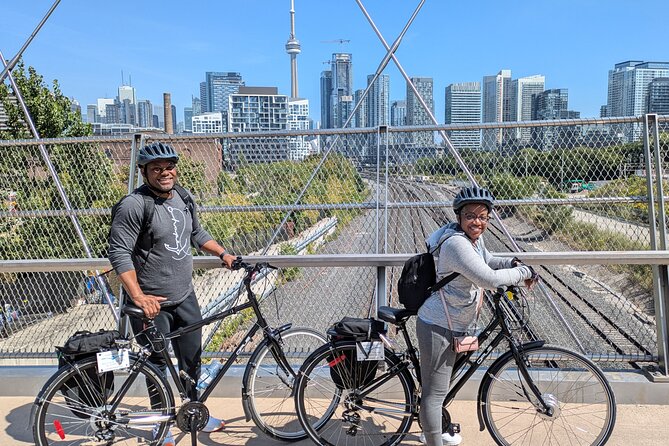
- Eight riders maximum: The small group makes it easier to ask questions and get help with the bikes.
- Toronto beyond the postcard: You visit Lower Ossington, St. James Town, Rosedale, CAMH, Trinity Bellwoods, and the waterfront.
- E-bike assistance matters: You cover a broad slice of the city without relying entirely on your own leg power.
- A strong local focus: The route looks at housing, food, healthcare, mental health, culture, and urban change.
- Useful extras included: Your bike, helmet, bottled water, and a granola bar are provided.
- Weather can change the plan: Poor conditions may lead to a new date or a full refund.
Why an e-bike is a smart way to see Toronto
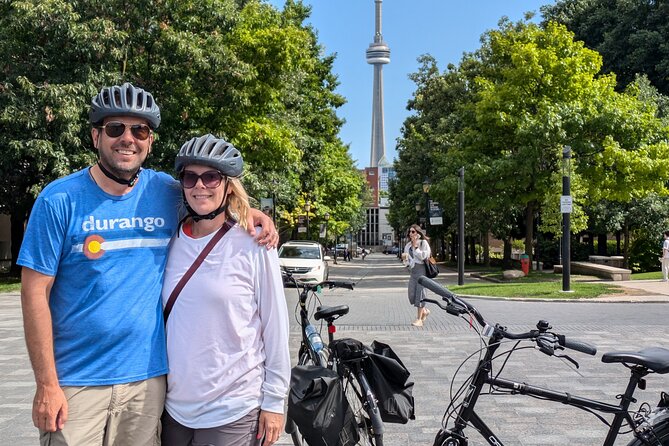
Toronto is too spread out for a short walking tour to connect these neighbourhoods well. Public transport can move you between major areas, but it does not give you the same sense of how one district changes into the next. An e-bike gives you more ground than a standard walking tour while keeping the pace human.
I like the balance here. You are not simply riding past a list of famous buildings. You stop to discuss places shaped by migration, art, social services, mental healthcare, redevelopment, and changing tastes. That gives the city more depth without turning the outing into a lecture.
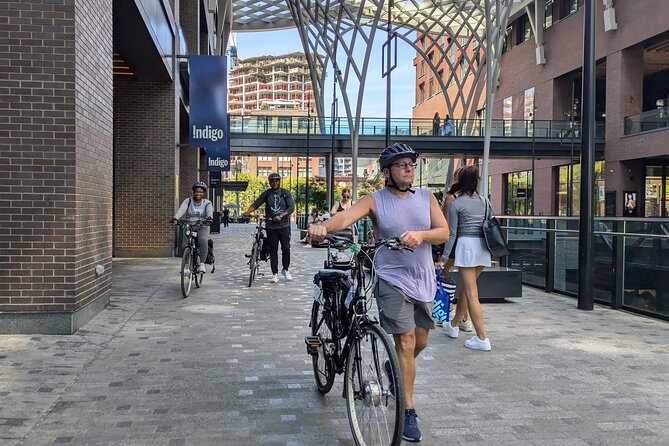
The group size matters. With a maximum of eight people, the guide can check that you are comfortable, answer questions, and deal with a bike problem without losing a large crowd. You should still expect to ride on city streets, so this suits you best if you are comfortable following road instructions and staying alert around traffic.
Before setting out, the guide makes sure you can handle the e-bike. That is especially useful if you have not used one before. One rider specifically praised this preparation, saying the guide checked comfort before heading onto the roads. That small step can make the difference between enjoying the city and spending the first hour worrying about the controls.
The equipment is included, along with a helmet, bottled water, and a granola bar. Those are modest extras, but they help on a three-and-a-half-hour outing. The bikes have occasionally needed battery changes or maintenance along the way. The good news is that the guide has handled those interruptions efficiently, but you should allow for the possibility of a short delay.
More Bike Tours in Toronto
- Toronto: Heart of Downtown 3.5-Hour Bike Tour
★ 4.9 · 419 reviews - Downtown Toronto Bike Tour
★ 5.0 · 336 reviews - Toronto Islands: Morning or Twilight 3.5-Hour Bike Tour
★ 4.8 · 304 reviews
Lower Ossington shows Toronto changing its mind
The first neighbourhood stop is Lower Ossington, a district that has moved from being largely overlooked to receiving international attention as one of Toronto’s coolest areas. You spend about 20 minutes here, long enough to get a feel for that change rather than merely passing through.
This is a useful opening stop because it introduces one of the tour’s main themes: Toronto is not fixed. Areas once treated as marginal can become prized for their restaurants, shops, art, and nightlife. That shift can bring new energy, but it can also change who can afford to live or work there. The tour presents the area as a transformation, not just a fashionable address.
I would pay attention to the contrast between the neighbourhood’s earlier reputation and its current profile. The value is in hearing how a place acquires a new identity, and how that identity affects the people already there. You get a better feel for Toronto as a city still being made, not a finished collection of attractions.
The 20-minute stop is not intended for a long exploration of every side street. Think of it as a focused introduction, with the e-bike doing the connecting work between stops.
St. James Town puts density and diversity at the center
St. James Town offers a very different view of the city. It is known as a world within a block, one of Toronto’s most densely populated and diverse neighbourhoods. The stop lasts about 20 minutes and focuses on how the community is responding to practical challenges involving social services, food, and healthcare.
This part gives the ride real purpose. Many city tours show attractive streets and historic buildings, then leave you with a polished but incomplete picture. St. James Town asks you to consider how a dense community organizes daily life and experiments with solutions.
The contrast with Lower Ossington is important. One stop examines a place reshaped by cultural popularity and commercial attention. The other looks at a community working through social needs. Together, they show why a neighbourhood tour can tell you more than a standard list of landmarks.
You should not expect a long visit inside community facilities, since the scheduled time is about 20 minutes. Instead, the stop provides context while you are moving through the city. If questions about housing, food access, healthcare, and local services interest you, this may be one of the most useful portions of the route.
The Bloor Street Cultural Corridor connects art and city life
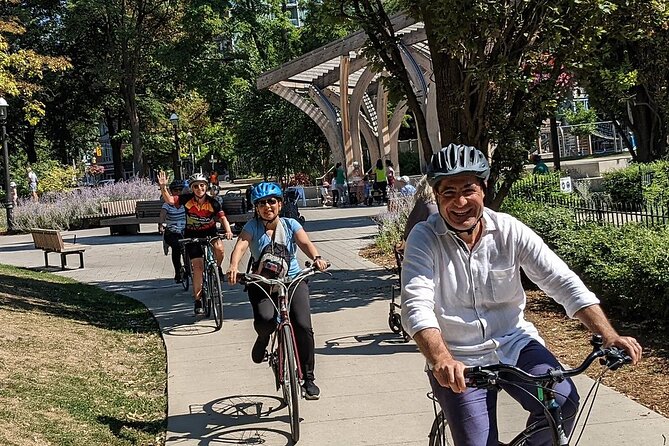
The Bloor Street Cultural Corridor brings Toronto’s arts and culture district into the route. It includes museums, cultural centres, performance spaces, and restaurants, making it less a single attraction than a concentrated stretch of city life.
The appeal here is variety. You get a sense of how culture works at street level, with formal institutions alongside places to eat and gather. This section helps connect Toronto’s public culture to its neighbourhood life rather than treating museums and performance venues as isolated stops.
The information provided does not assign a separate visit length to this corridor, so I would view it as part of the ride between the timed stops. You may see more than you could reasonably visit in one morning, but you should not expect admission to museums or performances. The tour includes bicycle use and basic refreshments, not attraction tickets.
That limitation is sensible. Adding several admissions would push up the price and make the timing difficult. Instead, you get an overview and can return later to the places that catch your interest.
Still Toronto, at a slower pace:
- Toronto: Niagara Falls Day Tour with Optional Boat Cruise
★ 4.6 · 3,178 reviews - Niagara Falls Day Tour from Toronto
★ 5.0 · 2,889 reviews - Toronto: Casa Loma Entry Ticket
★ 4.7 · 2,705 reviews - Niagara Falls Canada Day Tour From Toronto + Boat Cruise Option
★ 5.0 · 2,576 reviews
Graffiti Alley captures the city’s current mood
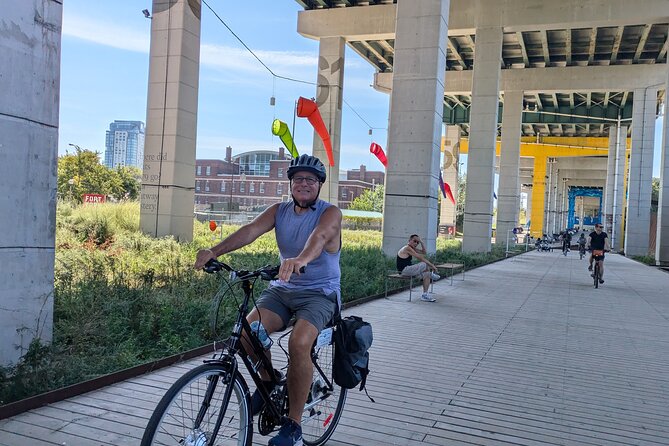
Graffiti Alley receives a 15-minute stop. Its street art offers a quick visual reading of Toronto’s present cultural mood, with walls and changing artwork doing much of the talking.
This is one of the easiest places to appreciate on a bike tour. You do not need a long explanation to understand why the alley matters. The art gives you an immediate sense of the city’s creative side, and a short stop is enough to look around and take photographs.
Still, 15 minutes passes quickly. If you want to study every piece or take many photographs, you may feel rushed. The stop works best as a vivid snapshot within a larger route, not as a full street-art tour.
I also like the contrast with the Bloor Street Cultural Corridor. One represents established arts institutions and performance spaces. The other presents art in an informal public setting. Placing both on the same ride gives you a broader idea of how Toronto expresses itself.
Rosedale reveals more than a polished address
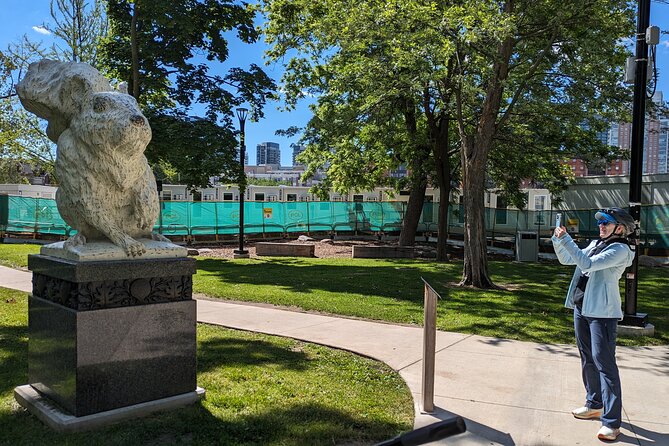
Rosedale is known as Toronto’s most fashionable address, with quiet streets and picturesque parkland. At first glance, it may seem far removed from the social and cultural questions raised in St. James Town or Lower Ossington. That is exactly why it belongs on this route.
The 20-minute stop looks at the neighbourhood’s subtle changes and the idea that there is more than meets the eye. You get a chance to consider how an affluent district evolves, even when its public image appears calm and settled.
This is not just a stop for pretty scenery. It adds social contrast. Toronto’s neighbourhoods do not share the same resources, pressures, or public image, and seeing them in one morning helps you understand the city’s uneven character.
The quiet setting may also offer a welcome break from busier streets. Since the tour covers several urban districts, the change in atmosphere is part of the experience. You should not expect a long walk through parkland, though. The scheduled stop is about 20 minutes, so the guide’s interpretation will matter as much as the view.
Ontario Place and Trillium Park show a waterfront in dispute
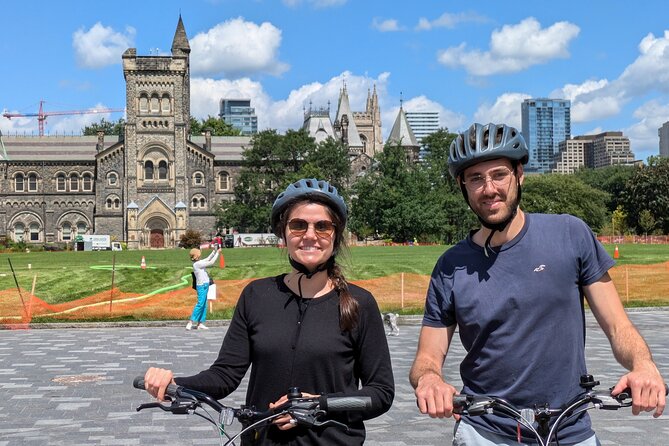
Ontario Place and Trillium Park bring the ride to an iconic waterfront venue undergoing major change and controversy. The stop lasts about 20 minutes, giving you time to consider both the setting and the arguments surrounding its future.
This is an important stop for anyone interested in how cities handle public space. Waterfront sites often carry competing goals: recreation, private development, cultural use, commercial investment, and public access. Ontario Place puts those tensions in one visible location.
The word controversy matters here. You are not being shown a finished attraction with a simple success story. You are seeing a place in transition, where decisions about the future affect how people use the waterfront. That makes the stop more timely than a standard sightseeing photo opportunity.
The area also changes the rhythm of the tour. After several neighbourhood stops, the waterfront gives you a wider setting and a chance to think about Toronto at the city scale. The guide’s explanation is likely to be central, since the value lies in understanding what is changing and why.
CAMH offers a serious look at mental health
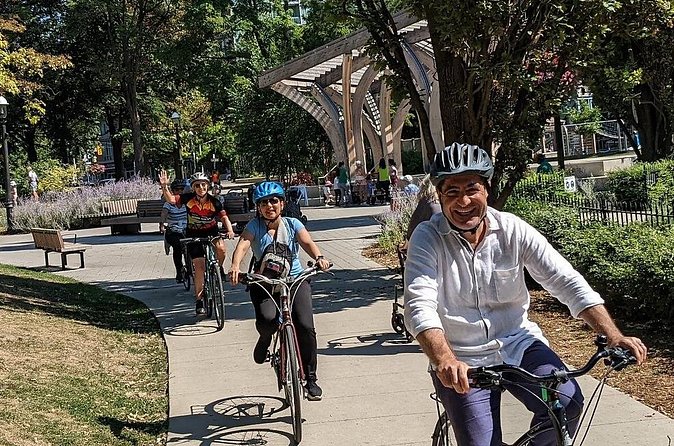
The stop at CAMH, the Centre for Addiction and Mental Health, lasts about 15 minutes. It explores Toronto’s progressive approach to mental health and the advances associated with the institution.
This is one of the tour’s most distinctive choices. Many sightseeing routes avoid subjects that are difficult, personal, or socially complex. Including CAMH shows you a Toronto that is trying to rethink mental healthcare and public attitudes toward it.
The stop is brief, so you should expect an introduction rather than a full institutional tour. Its importance comes from the subject and the guide’s context. You may leave with a clearer sense of why mental health belongs in a city’s public conversation and how Toronto has approached that work.
It also connects to the earlier discussion of social services in St. James Town. The ride repeatedly asks you to look at how the city supports people, not only how it attracts visitors. That gives the route a thoughtful thread.
Trinity Bellwoods links green space with local culture
Trinity Bellwoods is a significant green space and a cultural heartbeat for the city. The stop lasts about 10 minutes, shorter than most of the others, but it helps explain how public parks serve changing urban needs.
I see this as a transition point between the tour’s neighbourhood stories and its broader look at city life. Parks are not just patches of grass between buildings. They can be meeting places, cultural spaces, and pressure valves in a dense city.
Ten minutes is enough for a quick look and explanation, though not enough for a leisurely park visit. If you want time to sit, walk, or explore on your own, you would need to return separately. The tour’s purpose is to show how the park fits into Toronto’s changing social pattern.
The stop also gives the route a lighter pause after CAMH. That variety is welcome. Three and a half hours of serious urban topics could feel heavy, but the itinerary alternates cultural, social, residential, and outdoor settings.
What the $109.92 price really buys you
At $109.92 per person, this is not a cheap way to rent a bike for a few hours. You are paying for an organized route, an e-bike, a helmet, a guide, bottled water, a granola bar, and the convenience of linking distant parts of Toronto in one outing.
The value depends on your priorities. If you already know Toronto well, own a bike, and prefer to set your own route, the price may feel high. You could spend less by exploring one neighbourhood at a time, though you would give up the guide’s connections between them.
For a first visit, the price makes more sense. You see a wide range of neighbourhoods, hear why they matter, and avoid the planning work of building a route across the city. The maximum group size of eight also gives this a more personal feel than a large coach excursion.
No attraction admissions are included, but that is not a major weakness here. The route is about streets, public spaces, and interpretation. You are buying access to a way of understanding Toronto, not a bundle of indoor tickets.
Who will get the most from this ride
I would recommend this tour if you want to see Toronto as a living city rather than a checklist of major sights. It suits you especially well if you like neighbourhood change, public art, social issues, urban planning, and local culture.
It is also a good first-day activity. The route introduces several areas you may want to revisit, and the guide’s explanations can help you decide where to spend more time later. One rider specifically appreciated seeing the heart of Toronto rather than only its tourist side.
You should think twice if you dislike riding in city traffic, need a guaranteed dry-weather activity, or want long stretches of independent exploration at each stop. The tour has a full schedule, with stops ranging from 10 to 20 minutes, so the pace is designed for coverage and context.
Guiding appears to be a major strength. Ryan is praised for his city knowledge and for making the ride easy and enjoyable. Another guide, originally from Mexico City, was remembered for being thoughtful and well informed. Since guide quality can shape a city tour, that is a meaningful advantage.
The outing is offered in English. Confirmation arrives when you book, and the meeting point is 124 St Patrick St, Toronto, Ontario M5T 2X8. The ride returns to that same point, which simplifies the start and finish of your day.
Most people can participate, but the provided information does not give specific bike-fit, mobility, or road-skill details. If you have a concern, ask before booking rather than assuming the e-bike will solve every difficulty.
Should you book E-bike Toronto’s Dynamic Neighbourhoods?
I would book this if you want a compact, guided introduction to Toronto’s less obvious sides. The strongest reasons are the eight-person limit, the wide mix of neighbourhoods, and the guide’s emphasis on making riders comfortable before heading onto the roads.
The route is especially worthwhile for you if Lower Ossington, St. James Town, Graffiti Alley, CAMH, and Ontario Place sound more interesting than a standard downtown circuit. You get social context, public art, cultural institutions, wealthy residential streets, parkland, and waterfront debate in one morning.
I would skip it if your main goal is a slow park ride or a long visit at any single site. Also remember that the experience requires good weather. You can cancel for a full refund up to 24 hours before the start time, but late cancellations do not receive a refund. If poor weather cancels the outing, you are offered another date or a full refund.
FAQ
How long is the e-bike tour?
The tour lasts approximately 3 hours and 30 minutes.
What is the price per person?
The listed price is $109.92 per person.
Where does the tour start?
It starts at 124 St Patrick St, Toronto, ON M5T 2X8, Canada.
Where does the tour end?
The activity ends back at the meeting point on St Patrick Street.
How many people can join the tour?
The maximum group size is eight people.
Is the tour offered in English?
Yes. The experience is offered in English.
What is included in the price?
The price includes use of a bicycle, a helmet, bottled water, and a granola bar snack.
Which Toronto neighbourhoods and sites does the route visit?
The route includes Lower Ossington, St. James Town, the Bloor Street Cultural Corridor, Graffiti Alley, Rosedale, Ontario Place and Trillium Park, CAMH, and Trinity Bellwoods.
Can I cancel for a full refund?
Yes. You must cancel at least 24 hours before the experience start time for a full refund. Cancellations or changes made less than 24 hours before the start are not accepted for a refund.
What happens if bad weather cancels the tour?
Because the experience requires good weather, you will be offered a different date or a full refund if poor weather causes cancellation.
More E-Bikes in Toronto
- E-bike through Toronto’s Dynamic Neighbourhoods
★ 4.6 · 12 reviews - Epic Electric Bike Tour by Cycle City Tours
★ 5.0 · 848 reviews - Montreal eBike Sightseeing Tour
★ 5.0 · 573 reviews - eBike Adventure in Whistler
★ 5.0 · 365 reviews
Just added around Toronto
- Toronto Craft Brewery Tour★ 5.0 · 97 reviews
- Canada eSIM | 3-30 days | Daily data | QR code★ 4.0 · 12 reviews
- Handcrafted Donuts of Toronto: A Sweet City Walking Tour★ 5.0 · 141 reviews
- Underground Toronto PATH Tour★ 4.5 · 6 reviews
- Tour to Niagara Falls from Toronto★ 4.0 · 19 reviews
- Customizable Walking Tour of Toronto’s Hidden Gems★ 5.0 · 15 reviews
- Tour to Niagara Falls with skip the line Cruise★ 4.0 · 27 reviews
- Toronto Airport Private Transfer to Downtown★ 4.5 · 10 reviews
Cycling Tours, compared.

The Stanley Park Bicycle Tour by Cycle City Tours
Read our review →



Browse the lists this tour appears in