Reviewed · HISTORICAL TOURS
Walking Tour Through Quebec City’s History
Quebec City tells its story in stone. This small-group walk connects the upper town, the old cathedral, the lower streets, and the birthplace of the city in about two hours. I especially like the period-costumed guides, who turn dates and battles into personal stories, and the route itself, which gives you both grand views from Dufferin Terrace and close-up streets in Petit-Champlain. The main catch is physical: steep hills, cobblestones, and stairs are part of the experience.
Guides such as Kevin, Mark, Annabelle, Guy, Louise, Chantal, and Gary have earned praise for being funny, warm, and able to answer questions. The storytelling style can be dramatic, sometimes very dramatic, so you should enjoy a bit of theater along with your facts. At $24.03 per person, the tour is a sound way to get your bearings, but older walkers or anyone uneasy on steep descents should think carefully before booking.
In This Review
- Key points at a glance
- Why this two-hour walk works well
- Starting beside Quebec’s upper-town landmarks
- Dufferin Terrace: views beside Château Frontenac
- Notre-Dame de Québec and the weight of religious history
- Place Royale and the city’s 1608 beginning
- Petit-Champlain: the most atmospheric part of the route
- The Breakneck Steps are short, steep, and photogenic
- A guide-led history lesson, not an interior attraction tour
- Is $24.03 a fair price?
- Timing, group size, and what to bring
- Who should book this walking tour?
- Should you book it?
- FAQ
- How long does the walking tour last?
- Where does the tour start?
- Where does the tour end?
- Is the tour offered in English?
- How large is the group?
- Does the tour include the Basilica of Notre-Dame de Québec?
- Can I cancel for a full refund?
Key points at a glance
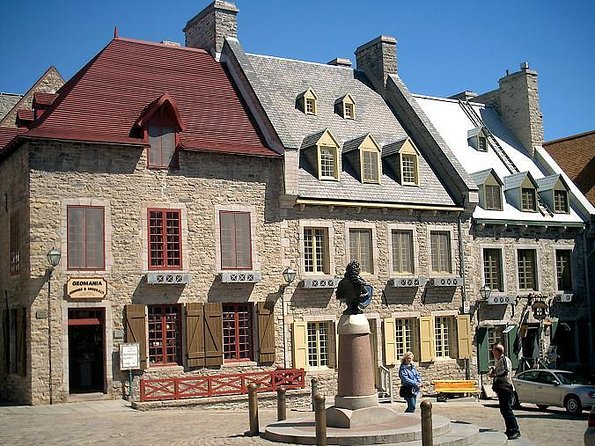
- A route from upper town to lower town: Start near 12 Rue Sainte-Anne and finish at Place Royale, with a downhill walk linking the city’s two levels.
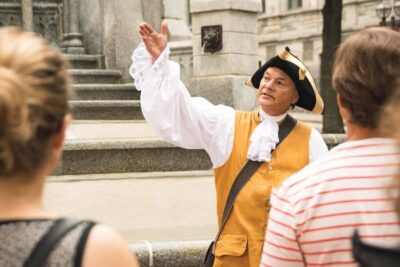
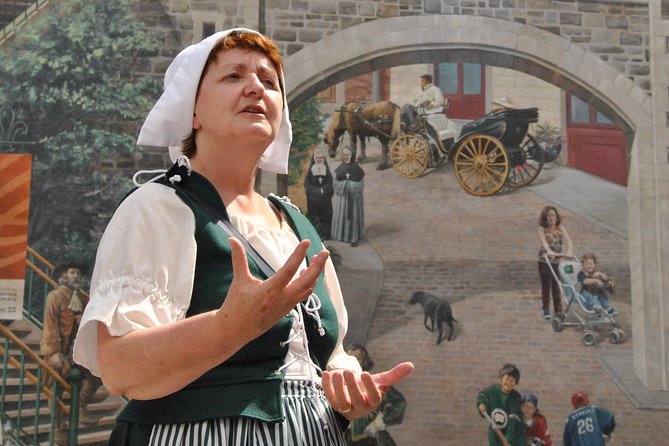
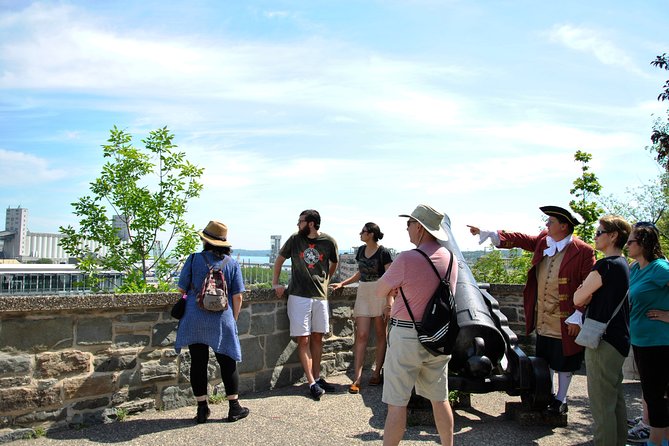
- History presented in character: Your guide wears period clothing and may speak from the viewpoint of a historical figure, making the past easier to remember.
- The best classic viewpoints: Dufferin Terrace brings Château Frontenac, the St. Lawrence River, and broad city views into one stop.
- A close look at Quebec’s birthplace: Place Royale marks where Samuel de Champlain founded Quebec City in 1608.
- Petit-Champlain takes the longest: You get about 45 minutes among old lanes, shops, stone buildings, and storybook views.
- Prepare for real exertion: Expect hills, stairs, uneven paving, and a descent down the old Breakneck Steps.
Why this two-hour walk works well
Old Quebec is easy to admire and surprisingly easy to misunderstand. You can stroll past a church, a square, or a handsome stone building without knowing why it matters. This tour gives those places a timeline, linking the French colony, British rule, religious power, trade, and the city’s growth across roughly 400 years.
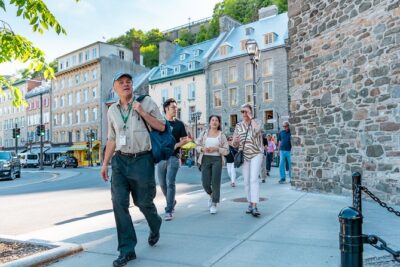
I like the small-group format, capped at 20 people. That is large enough to keep the tour running even if a few people are quiet, but still small enough for questions. Several guides have been praised for making room for questions, and that matters here because Quebec’s story includes unfamiliar names, changing rulers, and events spread across centuries.
The guides are the heart of the experience. The strongest reports describe a lively presentation rather than a dry lecture. Gary, for example, used the persona of an historical character and mixed humor with facts about daily life. Another guide played her role with great theatrical energy, which helped one participant understand the city and Canadian history more clearly, though the style felt slightly overdone at times.
That range is worth noting. Your guide may be calm and conversational, or may treat the street like a small stage. The period costume and character work are useful for families and first-time visitors, but people who want a quiet architectural walk may prefer a less performative format.
More City Tours in Quebec City
- Quebec City Walking Tour
★ 5.0 · 4,716 reviews - Quebec City: Guided Tour of Fairmont Le Château Frontenac
★ 4.7 · 3,027 reviews - Québec City: Guided Sightseeing River Cruise
★ 4.4 · 3,000 reviews
Starting beside Quebec’s upper-town landmarks
The meeting point is 12 Rue Sainte-Anne, close to the upper part of Old Quebec. From here, you are already in the city’s historic core, and the route quickly puts the old walls, religious buildings, and military setting into context.
This is a good tour to take early in your stay. One guide may help you understand the layout of upper and lower Quebec, while also pointing out places you can return to later. The walk ends in Place Royale, so you finish with a useful base for further exploring instead of being returned to the starting point.
A practical warning: confirm the meeting address carefully before you set out. One participant had trouble after being sent to the wrong location and then could not immediately find the guide. That appears to be an isolated organizational problem, but arriving a little early and checking your mobile ticket is sensible.
Dufferin Terrace: views beside Château Frontenac
The first timed stop is Dufferin Terrace, a long wooden promenade beside Château Frontenac. You have about 10 minutes here, which is enough for photographs and a first look across the St. Lawrence River.
This is one of the tour’s strongest openings. The terrace gives you a clear sense of Quebec City’s setting, with the river below and the old town gathered around the château and fortified heights. The guide can explain why this upper position mattered, while you take in one of the city’s most recognizable views.
The terrace is free to visit, and it works in every season, though conditions can affect how comfortable the walk feels. The tour requires good weather, so a cancellation because of poor conditions may lead to another date or a full refund.
Ten minutes is not long, and that is both good and bad. You get a strong introduction without standing still too long, but you will not have much time for a relaxed visit to the château itself. Treat Dufferin Terrace as a scenic orientation point, not a full attraction visit.
Notre-Dame de Québec and the weight of religious history
The route also brings attention to the Basilica of Notre-Dame de Québec, described in the tour information as a cathedral that has occupied the same location since 1647. Its architectural importance has earned it designation as a Canada National Historic Site.
Inside, the building contains works of art, archival pieces, elaborate decoration, and the graves of four governors of New France. A funerary chapel is dedicated to François de Laval, and you may also see the Holy Door.
There is an important expectation to set here. The experience is primarily a walking and storytelling tour, and one participant specifically noted that the group viewed buildings from outside only. Do not book this walk assuming you will receive a full interior visit or guided church tour. The basilica is part of the historical setting, but the actual amount of interior access may not be the main focus.
Even from outside, the stop has value. The cathedral represents more than religious architecture. It connects Quebec’s political leaders, bishops, church institutions, and ordinary worshippers to the city’s development. If the doors are open and time allows, you can decide how much longer to spend inside after the tour.
More History Tours in Quebec City
- Evening Gourmet Tour 5 Course Dinner – History and Food in Old Quebec City
★ 5.0 · 496 reviews - Quebec City: Old Quebec Historical Walking Tour
★ 4.8 · 409 reviews - Combo Historical and Food Tour of Old Quebec
★ 5.0 · 360 reviews - Old Quebec City Private Walking Tour : History and Nature
★ 5.0 · 104 reviews
Place Royale and the city’s 1608 beginning

Place Royale is one of the most important stops because it marks the place where Samuel de Champlain founded Quebec City in 1608. The square brings several layers together: French planning, later British influence, stone construction, and the city’s role as a colonial center.
You get about 15 minutes here, enough to hear the main story and look closely at the surrounding buildings. The architecture combines French and British influences, giving the square a character that differs from a purely French village or a later British town.
The oldest stone church in North America is also associated with this square. That detail alone makes Place Royale more than a photogenic stop. It helps explain why this small area matters so much to the city’s identity.
The tour ends here, which I consider a smart choice. You can continue exploring without having to climb back to the upper town immediately. Spend time examining the buildings, visit nearby attractions, or continue through Petit-Champlain at your own speed.
Petit-Champlain: the most atmospheric part of the route
The tour allows about 45 minutes in the Quartier Petit-Champlain, the longest portion of the itinerary. This is where the walk shifts from broad civic history to close-up street scenes.
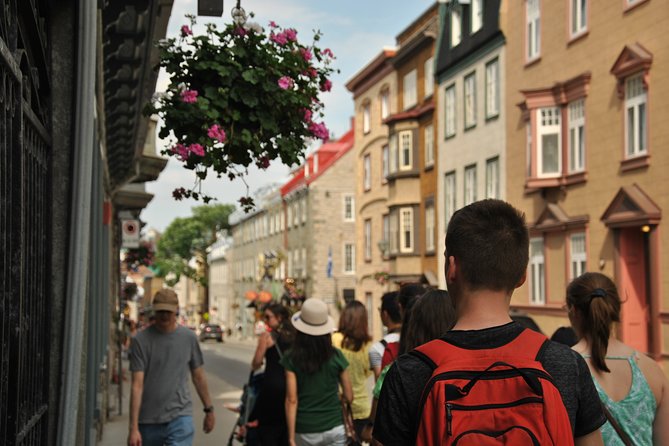
The district’s narrow streets and old buildings make the founding era feel more immediate. The route through Petit-Champlain and Place Royale is designed to help you picture the early settlement, while the small lanes and building fronts provide some of the city’s most memorable views.
I like having nearly three quarters of an hour here because this district rewards a slower pace. You can listen to the guide, take photographs, and notice the relationship between the upper and lower parts of Quebec City. The area has the storybook appearance many people hope to find in Old Quebec, but the guide keeps it from becoming just a pretty backdrop.
There is a tradeoff. Petit-Champlain can be crowded, and street activity may make it harder to hear. One participant also found that street cleaning and garbage collection interfered with the guide’s voice. Stay close to the guide, especially in noisy sections, and do not hesitate to ask for a point to be repeated.
The Breakneck Steps are short, steep, and photogenic
The Breakneck Steps, or L’Escalier Casse-Cou, take only about five minutes on the formal schedule. They are the oldest outdoor staircase in Quebec City and offer a classic view down toward Rue du Petit-Champlain.
The stop is brief, but it explains the physical character of the old town. Quebec is not a flat collection of pretty streets. It is built on different levels, and these stairs are one of the clearest reminders of that fact.
The name is not just playful marketing. The steps are steep enough that you should use care, especially on wet or icy days. The route also includes other hills and stairs, including the long downhill walk from the upper terrace toward the waterfront. Several people specifically advised wearing good walking shoes and being ready for the descent.
This is not a technical hike, but the tour requires moderate physical fitness. Anyone with knee, balance, or mobility concerns should take the elevation changes seriously. Service animals are allowed, and the tour is near public transportation, but the historic streets themselves remain uneven.
A guide-led history lesson, not an interior attraction tour
The best reason to book this experience is the guide’s ability to connect places with people. The strongest guides do not merely point at a building and recite its construction date. They explain how Quebec changed under different rulers, how people lived, and why certain locations mattered.
That approach made the tour especially useful for people who wanted more than a self-guided walk. One guide was praised for covering parts of the city that the group had not found on its own. Another helped make the upper and lower levels easier to understand during the rest of the trip.
The period costume adds a visual cue, and the role-playing can make difficult material stick. Gary’s humorous comments about his character being dead, along with surprising details about family life, show how the tour uses personality to keep attention.
Still, the theatrical approach is not perfect for everyone. A dramatic guide can occasionally compete with the buildings, and two hours of listening is a long stretch for younger children. One family suggested the experience was best for ages 12 and up. That is not a formal age rule, but it is useful advice if your children tire during walking tours.
Is $24.03 a fair price?
At $24.03 per person, this is a reasonably priced introduction to Old Quebec. You are paying for a local guide, a professional presentation, a planned route, and the convenience of having the major historical stops connected in one walk.
The value is strongest if this is your first day in the city. You get the basic map in your head, learn which areas sit above or below the others, and receive enough background to make later wandering more meaningful. The tour can save you from spending your whole first day simply trying to work out where the old city begins and ends.
The price is less compelling if you already know Quebec City well or prefer to explore silently with a guidebook. The stops themselves are free, and the tour does not promise a full interior visit to every building. Its worth comes from interpretation, route planning, and the guide’s storytelling.
With a 4.7 rating from 263 reviews and 92 percent recommending it, the experience has a strong record. The occasional complaints point to practical issues rather than a weak central idea: confusing meeting instructions, difficult stairs, noise, and a presentation style that may feel too dramatic for some people.
Timing, group size, and what to bring
The walk lasts about two hours, though you should allow extra time afterward in Place Royale. Since the tour starts in the upper town and ends lower down, plan your day around that direction rather than treating it as a loop.
Bring:
- Comfortable shoes with good grip
- Water, especially in warm weather
- Clothing suited to changing conditions
- A charged phone for the mobile ticket
- Patience for stops where street noise may make hearing harder
The maximum group size is 20. That is not a private tour, but it is small enough to keep the guide nearby if you stay toward the middle of the group. If you have questions, ask them during quieter moments rather than waiting until a busy street crossing.
Free cancellation is available if you cancel at least 24 hours before the start time. Changes or cancellations inside that window are not accepted for a refund. Weather or failure to meet the minimum number of participants can cancel the experience, in which case you are offered another date or a full refund.
Who should book this walking tour?
I would choose this tour if you want a clear introduction to Quebec City, enjoy stories more than a simple audio guide, and can manage hills and stairs. It suits couples, families with older children, and first-time visitors who want to understand the city before exploring it alone.
It is also a good fit if you like guides who perform a little. Kevin, Mark, Annabelle, Guy, Louise, Chantal, Gary, and others have been praised for humor, warmth, strong command of the subject, and lively delivery. The exact feel depends on who leads your group, but the format clearly favors personality.
I would hesitate if you need a fully accessible route, want a flat walk, or expect long indoor visits. The descent from Dufferin Terrace, cobblestones, and Breakneck Steps are not minor details. They shape the experience.
Should you book it?
Yes, if this is your first visit and you want a lively introduction to Old Quebec for a modest price. I especially recommend taking it near the start of your stay, when the route can help you plan the rest of your time.
Skip it if you already know the old city, dislike costumed role-play, or would struggle with steep stairs. For everyone else, this is a practical and entertaining way to connect Dufferin Terrace, Notre-Dame de Québec, Place Royale, Petit-Champlain, and the city’s 400-year story in one well-planned walk.
FAQ
How long does the walking tour last?
The tour lasts approximately two hours.
Where does the tour start?
It starts at 12 Rue Sainte-Anne, Québec, QC G1R 3X3, Canada.
Where does the tour end?
The tour ends at Place Royale, the historic birthplace of Quebec City. You can continue exploring the area afterward at your own pace.
Is the tour offered in English?
Yes. The experience is offered in English and includes a mobile ticket.
How large is the group?
The tour has a maximum of 20 participants.
Does the tour include the Basilica of Notre-Dame de Québec?
The route includes the cathedral area and discusses its history, art, archives, governors’ graves, François de Laval’s funerary chapel, and possibly the Holy Door. The tour is mainly an outdoor walking experience, so you should not assume a full interior visit.
Can I cancel for a full refund?
Yes, if you cancel at least 24 hours before the experience’s start time. Cancellations or changes made less than 24 hours in advance are not accepted for a refund.
More Walking Tours in Quebec City
- Old Quebec City: Grand Walking Tour with Private Option
★ 4.8 · 2,609 reviews - Old Quebec Classique Walking Tour with Funicular
★ 5.0 · 1,317 reviews - Quebec: Crimes of New France Animated Walking Tour
★ 4.6 · 926 reviews - Quebec City: Old Quebec Classic Walking Tour with Funicular
★ 4.9 · 695 reviews
Just added around Quebec City
- Wine Tasting on Ile d’Orleans★ 4.5 · 163 reviews
- YQB Airport Transfer★ 5.0 · 41 reviews
- Quebec City : Winter Magic Walking Tour★ 4.5 · 9 reviews
- Heritage Upper Town E-Bike Tour★ 5.0 · 6 reviews
- VIP Agritourism Tour of Île d’Orléans & Montmorency Falls (Lunch)★ 5.0 · 11 reviews
- Private Tour: Montmorency Falls & Ste-Anne-de-Beaupré from Québec★ 4.5 · 12 reviews
- 4 Hours Private Quebec City Guided Tour★ 5.0 · 83 reviews
- A Taste of History Walking Tour★ 4.5 · 86 reviews
Historical Tours, compared.



Evening Gourmet Tour 5 Course Dinner – History and Food in Old Quebec City
Read our review →