

Reviewed · SELF-GUIDED TOURS
Old Town Quebec Secrets: Private Exploration Game and Tour
Old Quebec rewards curious walkers. This offline puzzle tour turns a sightseeing stroll into a small history hunt, leading you through grand squares, old gates, churches, and easily missed details. I like the freedom to begin and pause whenever you want, and I like that children play free. The main catch is that the app has had some outdated clues and wording problems, so competitive puzzle-solvers may lose patience.
At about 90 minutes, this is a compact way to get oriented in the old city without joining a scheduled group. You follow step-by-step directions through the Questo app, answer location-based challenges, and reveal the next stop. At $9.29 per person, the price is modest, though a free walking route or a $5 alternative mentioned in one unhappy experience may appeal more if the technology fails.
In This Review
- Key points to know before you play
- Starting near Parliament Hill and the Tourny Fountain
- Saint-Louis Gate and the old cannonball tree
- The Ursulines and Montcalm’s final resting place
- Holy Trinity Cathedral and the changing Place de l’Hôtel-de-Ville
- The Séminaire de Québec and the founder’s monument
- Jean-Paul Lemieux and art in the old city
- Place Royale, the cradle of French North America
- Parliament, city hall, and Notre-Dame-de-Québec
- How the puzzle format works in real life
- Price, group size, and practical value
- Who will enjoy this Old Quebec game most?
- Should you book Old Town Quebec Secrets?
- FAQ
- How long does Old Town Quebec Secrets take?
- How much does the experience cost?
- Is the experience guided by a person?
- Can I play without internet access?
- Can I pause and restart the game?
- Where does the game start?
- Where does the game finish?
- Can children participate for free?
- What is the cancellation policy?
Key points to know before you play
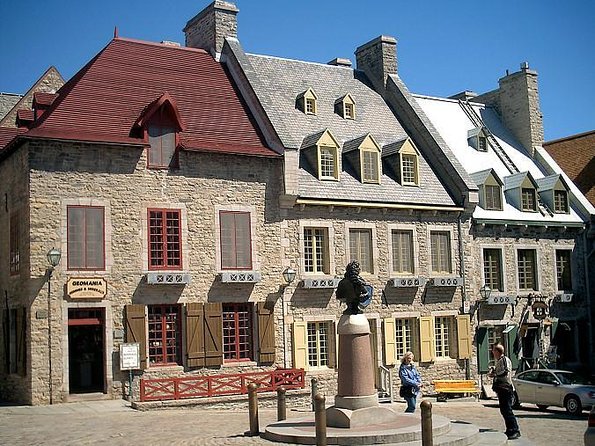
- Fourteen historic stops connect Upper Town with Place Royale, giving you a broad Old Quebec introduction in a short walk.
- The game works without mobile data or internet, useful if you want to avoid roaming charges.
- You control the clock, since the activity can begin after booking and pause whenever you need.
- The puzzles make you inspect buildings and street details, not just follow a guide from one postcard view to the next.
- The experience is private, so only your group plays together, with group discounts and extra bookings possible for parties over 15.
- The app is the weak link, with some clues reported as outdated or confusing.
Starting near Parliament Hill and the Tourny Fountain

The listed starting point is 3004 Avenue Honoré-Mercier, near the Parliament Building and the Tourny Fountain. The app guides you step by step toward Place Royale, so you should read the directions closely before setting off. Since this is self-guided, you will not find a person waiting to explain the route or rescue you if you miss a turn.
The Tourny Fountain is a good first puzzle because it looks decorative at first glance, yet carries a tidy bit of international history. French sculptor Mathurin Moreau designed the original work in 1853. Six copies were made, and the fountain appeared at the 1855 World’s Fair in Paris. Your task is to inspect the site and find an answer before the game sends you onward.
That method matters. Instead of receiving every fact in a speech, you must look at the place around you. If your group enjoys riddles, architecture, and small discoveries, the fountain becomes more than a quick photograph. If you prefer a smooth spoken explanation, the opening may feel slow or fussy.
A few more Quebec City trips worth comparing
- Quebec City Walking Tour
★ 5.0 · 4,716 reviews - Quebec City: Guided Tour of Fairmont Le Château Frontenac
★ 4.7 · 3,027 reviews - Québec City: Guided Sightseeing River Cruise
★ 4.4 · 3,000 reviews
Saint-Louis Gate and the old cannonball tree
The first Saint-Louis Gate dates to the late 17th century, when Quebec was under French rule. Later, during the British period, soldiers closed the gate at night to restrict movement between the city and the outlying areas. That policy hurt trade and made life harder for the growing settlement.
The game asks you to look around the gate for the answer. This is a useful way to notice how Quebec was once a fortified town, not simply a pretty district of stone facades. The stop also gives you a better sense of the relationship between the old city and the areas beyond its walls.
Next comes one of Old Quebec’s best oddities: the elm tree on Rue Saint-Louis near Rue du Corps-de-Garde. A large cannonball appears trapped in its twisted roots. Horse-drawn carriage drivers have long pointed it out, and curious passersby stop to study the strange pairing.
This is exactly the sort of stop a standard city route might rush past. You are asked to inspect the tree and solve the clue, which gives the object a little drama. Do not expect a major monument here. The pleasure is in spotting a detail that can be easy to miss while walking toward the next church or square.
The Ursulines and Montcalm’s final resting place
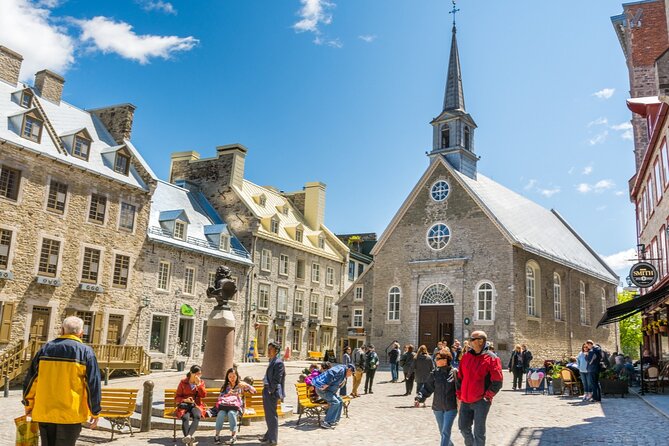
The Couvent des Ursulines was founded in 1639 and is the oldest institution of learning for women in North America. Its chapel is also connected to General Louis-Joseph Montcalm, the French commander who died after the 1759 battle that changed the future of New France.
The stop links education, religion, and military history in one compact setting. You get a reminder that Old Quebec’s story is not only about fortifications and colonial power. Religious communities also shaped schooling and daily life.
The app sends you searching for an answer at the site. This can make the visit more active, but it also means the amount of explanation depends on how well the clue works. One piece of practical advice: take your time reading each prompt. A hurried answer can send you back over ground you have already covered.
Holy Trinity Cathedral and the changing Place de l’Hôtel-de-Ville
The Cathedral of the Holy Trinity was completed in 1804 as the first Anglican church built outside Britain. Its neoclassical Palladian design was modeled after St Martin-in-the-Fields in London. It later became a National Historic Site of Canada in 1989.
For you, this is a useful contrast with the French Catholic churches nearby. Old Quebec’s buildings make more sense when you notice the competing French and British traditions side by side. The game uses the cathedral as another visual puzzle, asking you to examine the building rather than simply read a label.
The route then reaches the square now known as Place de l’Hôtel-de-Ville. Its earlier names included Grande Place, Grande Place de la Haute Ville, Place du Marché, Place Notre-Dame, and Place de la Basilique. After city hall was built, the name Place de l’Hôtel-de-Ville became common in 1900.
Place names often reveal how a city changes. A market square becomes associated with a civic building, while older religious names continue in everyday use. I like this stop because it asks you to pay attention to the public space itself, not only the famous structure beside it.
Still Quebec City, at a slower pace:
- Half-Day Trip to Montmorency Falls and Ste-Anne-de-Beaupré from Quebec city
★ 4.0 · 2,718 reviews - Tadoussac/Charlevoix: Whale Watching Zodiac Tour
★ 4.3 · 2,716 reviews - Old Quebec City: Grand Walking Tour with Private Option
★ 4.8 · 2,609 reviews - Quebec City: Montmorency Falls with Cable Car Ride
★ 4.6 · 2,392 reviews
The Séminaire de Québec and the founder’s monument
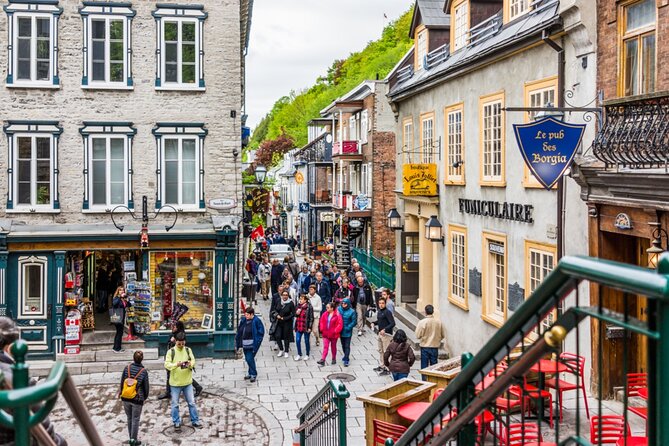
The Séminaire de Québec was founded in 1663 by François de Laval, who became the first bishop of Quebec. The society trained priests, worked to convert Indigenous people, and administered the colony’s parishes.
This stop gives the route a wider purpose. The seminary was not merely a religious building. It helped organize education, church administration, and French colonial life. You will be asked to find another answer by examining the surroundings, then continue toward the next location.
The route also includes a monument honoring the founder of Quebec City. Paul Chevré created the work, which was inaugurated in 1898. The itinerary does not provide a full description of the monument, so the puzzle itself becomes your invitation to look closely at its design and setting.
That lack of a physical guide is important here. A human guide could explain the symbolism, point out small figures, and answer questions. The app can still lead you there, but you will need to supply your own curiosity.
Jean-Paul Lemieux and art in the old city

Jean-Paul Lemieux was born in 1904 and died in 1990. He was one of Canada’s leading 20th-century painters and worked in five artistic periods, each showing a different style.
The game brings art into a route otherwise heavy with military, religious, and political history. This change of subject helps keep the walk from feeling like a string of dates. You are not only looking at buildings from the French and British periods. You are also being directed toward Canada’s modern artistic story.
The challenge requires you to inspect the location for an answer. If you enjoy museums and visual details, this may be one of the more appealing stops. If you want the app to explain Lemieux’s five periods in depth, you may find the information brief.
Place Royale, the cradle of French North America
The route’s historic heart is Place Royale. This is the precise location where Samuel de Champlain built the first permanent French settlement in the Americas in 1608. His first habitation served as a fort, store, trading post, and residence all at once.
That combination tells you why the square matters. It was not built as a ceremonial plaza from the beginning. It was a working base for trade, protection, and settlement. Place Royale is often called the cradle of French North America, and the game uses it as the endpoint.
The stated end point is Rue des Pains Bénits, and the app guides you to Place Royale step by step. Pay attention to the directions around the final part of the route. The starting address is near the Parliament area, while the finish is in Lower Town, so you are covering a useful stretch of Old Quebec rather than circling one small square.
Parliament, city hall, and Notre-Dame-de-Québec

Three later stops widen the story beyond the early settlement.
The Parliament Building, or Hôtel du Parlement, is an eight-story building designed by Eugène-Étienne Taché. Construction ran from 1877 to 1886, and it now houses Quebec’s Parliament, including the Lieutenant-Governor and National Assembly. Its size and formal design show Quebec City functioning as a modern political capital, not just a colonial outpost.
The route also visits Quebec City Hall. It opened on September 15, 1896, in Old Quebec and was built on a slope over the former Jesuit College, also called the Jesuit Barracks. The building was designated a National Historic Site of Canada in 1984. Look at how the structure sits on the hill, since the slope is part of the story.
Notre-Dame-de-Québec adds the strongest religious thread. It has served as the first Catholic parish in North America since 1664. It became a cathedral in 1674, when it became the seat of the Diocese of Quebec, and received basilica status two centuries later.
The building has suffered shelling, fires, reconstructions, and renovations. That history gives the final church stop real weight. You are looking at a place shaped by repeated damage and rebuilding, not a single untouched relic.
How the puzzle format works in real life
This is not a guided tour with a person leading you. It is a private city game delivered through the Questo app. At each location, you search for a detail, answer a challenge, and receive instructions for the next stop.
The best part is the freedom. You can begin at any time after booking, pause for coffee or lunch, and continue without rescheduling. The game is available every day from midnight to 11:30 p.m., according to the listed hours. That makes it easy to fit around a museum visit, dinner reservation, or changing weather.
You also play offline, so you do not need a data connection or internet access during the game. You should still make sure the app and necessary content are ready before walking away from reliable service. The experience information specifically promises offline play, while one poor experience reported that the game never worked. That makes a quick pre-walk check sensible.
The puzzles are engaging when they function properly. One positive experience described the route as a perfect mix of architecture, sightseeing, history, riddles, and puzzles, while another found it fun but challenging and needed hints several times. Expect to use hints rather than treating them as failure. They are there to keep a small technical or wording problem from stopping the entire walk.
Price, group size, and practical value
At $9.29 per person, this is inexpensive for a 90-minute private activity. The strongest value comes when you have two or more people who enjoy solving clues together. You are paying less for a formal history lesson and more for a structured reason to walk through much of Old Quebec.
Children play free, which improves the value for families. Group discounts are available, and groups larger than 15 can make multiple bookings. Since only your group participates, you can set your own pace and avoid being tied to strangers.
The tradeoff is simple: there is no physical guide. You receive no live correction, local conversation, or spontaneous detour. Also, some clues have been reported as outdated by more than a year because of construction or changes around the city. Poor wording has caused confusion, especially for people who approach the game competitively.
I would treat the route as a playful sightseeing aid, not as your only source of historical information. The facts are appealing, but the game format keeps explanations short.
Who will enjoy this Old Quebec game most?
I would recommend it most strongly to families, couples, and friends who like walking with a goal. It suits people who enjoy architecture, history, visual scavenger hunts, and light competition. The free child admission is especially helpful for a family vacation.
It is also a good choice if you have already seen the main streets and want a reason to notice smaller details, such as the cannonball in the elm tree. One family found it added fun and discovery to a Quebec vacation, and that is a fair description of its best use.
You may want a conventional guided walk instead if you need dependable historical commentary, have limited time, or dislike app-based activities. The route takes about an hour and a half, but technical problems or tricky clues can stretch that time.
The experience is near public transportation, service animals are allowed, and most people can participate. The information does not provide a detailed accessibility assessment for every street or building, so ask the provider if mobility concerns are important for your group.
Should you book Old Town Quebec Secrets?
Book it if you want an affordable, flexible way to explore Old Quebec and your group enjoys solving puzzles. The route covers a strong range of places, from Tourny Fountain and Saint-Louis Gate to Place Royale, Parliament, city hall, and Notre-Dame-de-Québec. The offline feature and free child admission add real practical value.
Skip it if you want a polished, fully updated explanation from a live local guide. The app has received a mixed reception, and the reported failures and stale clues are worth taking seriously. If you book, prepare the game before starting, allow extra time for hints, and treat wrong or awkward wording as a minor nuisance rather than a contest.
Free cancellation is available until 24 hours before the start time. Inside that window, the payment is not refunded and changes are not accepted.
FAQ
How long does Old Town Quebec Secrets take?
The game takes approximately 1 hour and 30 minutes.
How much does the experience cost?
The listed price is $9.29 per person.
Is the experience guided by a person?
No. There is no physical tour guide. You follow directions and challenges through the Questo app.
Can I play without internet access?
Yes. The game is designed to work offline, without mobile data or an internet connection.
Can I pause and restart the game?
Yes. You can begin after booking and pause the game whenever it suits you, without rescheduling.
Where does the game start?
The listed starting point is 3004 Avenue Honoré-Mercier, Quebec City, Quebec G1A 1A2, Canada.
Where does the game finish?
The listed end point is Rue des Pains Bénits in Quebec City. The app guides you step by step to Place Royale.
Can children participate for free?
Yes. The experience states that children play free.
What is the cancellation policy?
You can cancel at least 24 hours before the start time for a full refund. Cancellations or changes made within 24 hours are not accepted and are not refunded.
Just added around Quebec City
- YQB Airport Transfer★ 5.0 · 41 reviews
- Wine Tasting on Ile d’Orleans★ 4.5 · 163 reviews
- Quebec City : Winter Magic Walking Tour★ 4.5 · 9 reviews
- Heritage Upper Town E-Bike Tour★ 5.0 · 6 reviews
- VIP Agritourism Tour of Île d’Orléans & Montmorency Falls (Lunch)★ 5.0 · 11 reviews
- 4 Hours Private Quebec City Guided Tour★ 5.0 · 83 reviews
- A Taste of History Walking Tour★ 4.5 · 86 reviews
- Private Tour: Montmorency Falls & Ste-Anne-de-Beaupré from Québec★ 4.5 · 12 reviews
Self-Guided Tours, compared.


Vancouver Bike or Ebike Rental – Self Guided Map provided
Read our review →
Icefields Parkway: a Smartphone Audio Driving Tour
Read our review →


Niagara: Behind The Falls, Skylon Tower Ticket & Tesla Audio Tour
Read our review →
Vancouver to Whistler Seaplane Day Trip: Self-Guided Adventure
Read our review →
Browse the lists this tour appears in