
Reviewed · HISTORICAL TOURS
Half-Day Historical Tour of Halifax
Halifax tells its stories in layers. This six-hour tour links the city’s military past, Titanic graves, the 1917 explosion, waterfront trade, and Dartmouth fishing life in one comfortable day. I especially like the small maximum of 10 people and the way guide Paul McNeil uses a tablet with photographs, videos, and presentations to make difficult history easier to understand. The round-trip pickup from downtown hotels or the cruise port is another real plus.
The main thing to consider is the pace. The itinerary covers a huge stretch of Halifax Regional Municipality, so some places are driving stops with narration rather than long visits. If you want museum time, extended photography, or a slow walk through every site, this tour may feel packed.
The tour costs $131.43 per person and includes transportation, bottled water, and WiFi. That is not a bargain basement price, but it can be good value if you want broad coverage, personal guiding, and transportation to sites that are spread across Halifax and Dartmouth.
In This Review
- Key points at a glance
- Why Paul’s Halifax stories make a difference
- From Pier 21 to the Seaport Market
- The waterfront, boardwalk, and harbor defenses
- Churches, government buildings, and old Halifax
- Cemeteries and Halifax’s difficult stories
- The Public Gardens and Halifax Citadel
- The Halifax Explosion, from the Mont Blanc anchor to Hydrostone
- Titanic graves at Mount Olivet and Fairview Lawn
- Dartmouth, seafood, Lake Banook, and Fisherman’s Cove
- The van, timing, and value
- Should you book the Halifax Historical Tour?
- FAQ
- How long is the Halifax historical tour?
- Where does the tour begin and end?
- How many people can join the tour?
- Is lunch included?
- Is admission to the Halifax Citadel included?
- What is included in the tour price?
Key points at a glance

- Paul McNeil’s local storytelling: Paul brings long experience in Halifax transportation and touring, with detailed explanations of the city’s people, buildings, disasters, and military past.
- A serious look at Titanic and the Halifax Explosion: You visit Fairview Lawn Cemetery, Mount Olivet Cemetery, the Mont Blanc anchor site, and the Explosion Memorial Bell Tower.
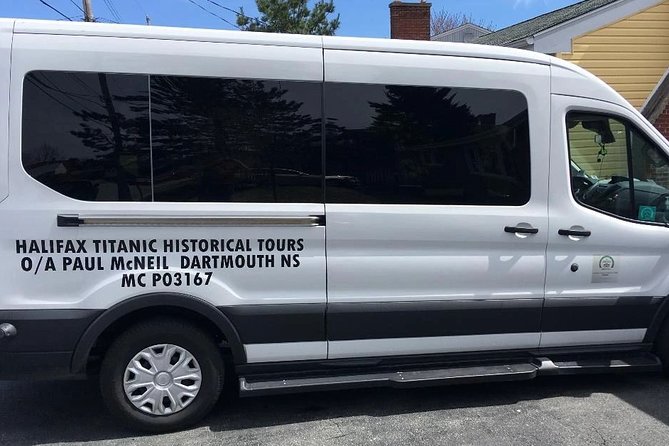
- Small-group van touring: The Ford Transit 350 XLT high-roof van carries four to 10 people, making pickups and short stops easier than on a large coach.
- Noon at the Citadel: Timing is arranged around the noon gun and the changing of the guard, two of Halifax’s best-known living traditions.
- Dartmouth and Fisherman’s Cove included: You cross beyond the downtown core for seafood, Lake Banook, and a restored fishing village.
- Cruise passengers need a timing check: A short port call can mean skipping Fisherman’s Cove or other stops, and the tour ends back at the original meeting point.
Why Paul’s Halifax stories make a difference

This is not simply a ride past old buildings. Paul McNeil presents Halifax as a place shaped by military defense, immigration, shipping, religion, tragedy, and rebuilding. His presentation is supported by a mounted tablet showing photographs and short video clips, a useful touch when you are looking at a site that has changed greatly over time.
The strongest praise centers on Paul’s preparation, punctuality, care with passengers, and command of local detail. You can expect plenty of information. This suits you if you like a guide who keeps talking and connects one place to the next. It may be less suitable if you prefer a quiet ride or a loosely structured outing.
The group size matters. With four to 10 people, Paul can manage hotel and port pickups without the long delays common to big buses. The high roof of the van also makes getting in and out easier, an advantage if stairs and long walks are difficult for you.
Seating goes to the first confirmed bookings, so early booking is useful if you care where you sit. The tour is often reserved well ahead, with an average booking lead time of about 78 days.
More History Tours in Halifax:
- Peggy’s Cove & Halifax Historic Tour
★ 4.5 · 375 reviews - Historic Halifax by Foot
★ 4.5 · 191 reviews - Peggy’s Cove/Mahone Bay & Lunenburg UNESCO HERITAGE SITE.
★ 4.5 · 139 reviews
From Pier 21 to the Seaport Market
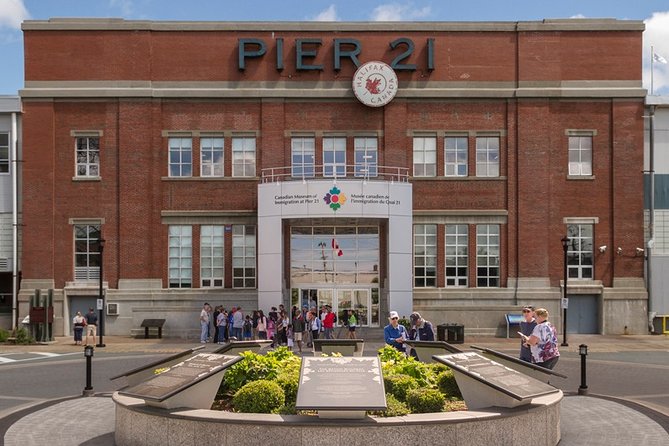
The day begins at Pier 22 on Marginal Road, or with pickup from a listed downtown hotel. One of the first stories concerns Pier 21, once a major gateway for newcomers to Canada. It is a fitting opening because Halifax has long been a point of arrival, departure, military movement, and family separation.
At the Halifax Seaport Farmers’ Market, you hear how the market began by Royal Proclamation in 1750, just a year after Halifax was founded. It moved around the city over the centuries before arriving at the Seaport in 2010. Today, more than 250 vendors operate there, and the market claims the distinction of being North America’s longest continuously running market.
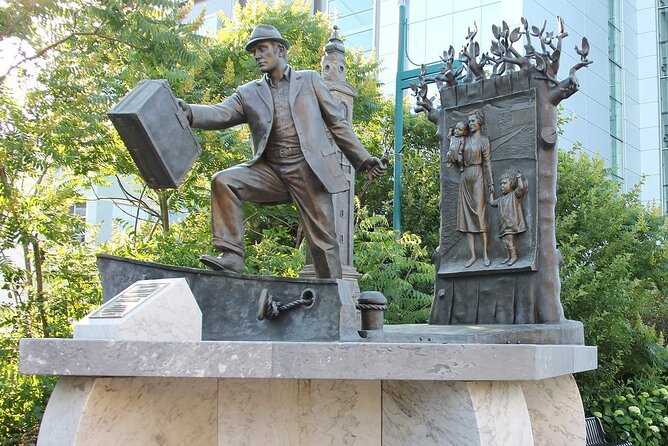
The tour also introduces Armando Barbon’s immigration memorial. The sculpture shows Armando stepping from a ship, while his wife Yole and their children appear in a family tree. His family followed five months later. The inscription focuses on the pain of separation and the hope that carried him through it. It gives the immigration story a human face rather than treating it as a date in a textbook.
You will also hear about Sir Samuel Cunard, the Halifax-born shipping magnate who founded the Cunard Line. His family had fled the American Revolution and settled in Halifax, and his rise connects the city to the wider Atlantic shipping world.
The waterfront, boardwalk, and harbor defenses
Halifax’s waterfront is one of the tour’s visual anchors. The downtown boardwalk runs beside the world’s second-largest natural harbor, and the guide explains the waterfront’s working past as you move along it. Views of Georges Island add another layer.
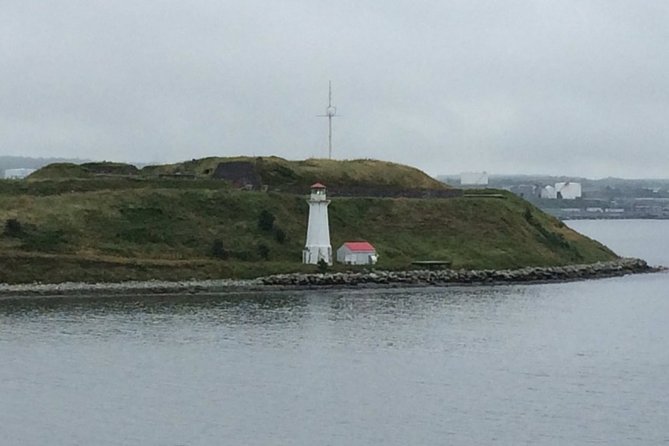
Georges Island occupied a key position in the harbor’s defenses. British forces took control of it in 1750, and it later held Fort Charlotte, seaward-facing batteries, tunnels, and one of Canada’s first fully automated lighthouses. The island also served as a prison and holding area for Acadians during the deportation of 1755 to 1763.
The underground passages have fed local folklore for generations. You will hear about the island from the mainland, but this tour does not promise an island visit. That distinction matters if you are expecting to explore the fortifications on foot.
Alexander Keith’s brewery is another waterfront landmark. Its Nova Scotia brewery first opened nearly 200 years ago and remains a working brewery producing small-batch beer inspired by local culture and Keith’s background. The tour provides historical context, but alcohol is not included, and this is not presented as a brewery tasting tour.
The naval story continues with HMCS Sackville, the only surviving one of the 269 Allied corvettes from the Second World War. It is a National Historic Site and serves as Canada’s Naval Memorial.
If you have extra time before or after the tour, the Maritime Museum of the Atlantic is a smart companion visit. Its exhibits cover the age of sail, steamships, wartime convoys, Titanic, and the Halifax Explosion. The tour recommends it, but museum admission and dedicated museum time are not part of the six-hour outing.
Churches, government buildings, and old Halifax
Much of Halifax’s character appears in buildings rather than grand viewpoints. You hear about Historic Properties, a restored group of waterfront warehouses dating from the late 1700s and early 1800s. It was the first restoration project of its kind in Canada and remains one of the most useful places to see the city’s commercial past.
Saint George’s Round Church offers a stranger tale. Built in 1800 for the growing congregation of the Little Dutch Church, it is a cylindrical wooden building in the Palladian style. The guide explains its sad history and the architectural choices that make it one of Halifax’s unusual landmarks.
St. Paul’s Church, founded in 1749, was the first Anglican cathedral built outside England and is the oldest building in Halifax. Look for the Ghost Window and the piece of wood set into an interior wall, both linked to the Halifax Explosion of 1917.
The route also passes Halifax City Hall, built from 1887 to 1890, and Province House, opened in 1819. Province House is Canada’s oldest legislative building and home to the country’s first elected House of Assembly. Government House, the oldest official residence in Canada, has been the working home of Nova Scotia’s lieutenant governor for more than two centuries.
Other downtown sights include St. Mary’s Cathedral Basilica, the Halifax Court House, the Cathedral Church of All Saints, and a modern library whose design resembles a stack of books. These stops give you a broad look at Halifax architecture, from Gothic Revival and Italian Renaissance styles to a contemporary public building.
You also hear about Maud Lewis, the famous Nova Scotia folk artist. Her story adds an artistic and personal counterpoint to the military, political, and disaster themes.
A few more Halifax trips worth comparing
- Halifax Harbour Hopper Tour
★ 4.5 · 1,296 reviews - Halifax Peggy’s Cove Express
★ 4.0 · 801 reviews - Halifax Small-Group Express To Peggy’s Cove
★ 4.2 · 651 reviews - Wine and Lunch Escape
★ 5.0 · 562 reviews
Cemeteries and Halifax’s difficult stories

This tour handles Halifax’s somber history directly. At the Old Burying Ground, more than 1,200 headstones and footstones record the city’s early years. The walled, tree-filled site is also an urban green space, with a Crimean War monument facing Barrington Street.
Fort Massey Cemetery contains the graves of British and Canadian soldiers, veterans, and spouses. Holy Cross Cemetery, established in 1843, contains about 25,000 burials, many of them Irish. Sir John Sparrow Thompson, Canada’s fourth prime minister, is buried there.
Holy Cross also contains Our Lady of Sorrows Chapel. More than 1,800 people helped build the small chapel in a single day in 1843, and its French stained-glass windows date from the 16th and 17th centuries.
Camp Hill Cemetery is a key stop. Established in 1844 to replace the Old Burying Ground, it includes the graves of Viola Desmond, Alexander Keith, Joseph Howe, Titanic survivor Hilda Mary Slayter, and John Taylor Wood, a Confederate naval officer with notable family connections. The stop here is about 10 minutes, so expect an overview rather than time to study every marker.
These cemetery visits are meaningful, but they are not light sightseeing. If stories of mass death and disaster are difficult for you, know that Titanic and the Explosion receive sustained attention throughout the tour.
The Public Gardens and Halifax Citadel
The 17-acre Halifax Public Gardens is one of the day’s most pleasant breaks. Enclosed by an ornate wrought-iron fence, the Victorian garden contains floral displays, semi-tropical plants, trees, statues, and fountains. You get about 30 minutes, enough for a walk and photographs, though not enough for a leisurely exploration of every corner.
At Halifax Citadel National Historic Site, the timing aims for the noon gun at exactly noon, followed by the changing of the guard by the 78th Highlanders. This is one of the tour’s strongest moments because it connects the city’s present-day visitor experience to the military purpose of the hill.
The current Fort George was completed in 1856 and is the fourth fort built on Citadel Hill. Its star shape, deep ditch, heavy walls, and sweeping firing angles explain why Halifax was such an important British naval base.
The admission fee for the Citadel is not included. The scheduled visit is about 15 minutes, so you should not expect a full fort tour. You are mainly there for the ceremony and the guide’s explanation.
The nearby Old Town Clock dates from an idea promoted by Prince Edward, Duke of Kent, in 1800. The clock was intended to correct the local garrison’s habit of tardiness. You have about 15 minutes here, usually enough for photos and a quick look.
The Halifax Explosion, from the Mont Blanc anchor to Hydrostone
The Explosion section is the emotional center of the day. On December 6, 1917, the munitions ship SS Mont Blanc blew up in Halifax Harbour, killing about 1,900 to 2,000 people, injuring roughly 9,000, and leaving 25,000 homeless. It was the largest human-made explosion before the atomic bomb.
At the Mont Blanc anchor site, you see a 1,140-pound anchor shaft thrown about 2.3 miles by the blast. Another cannon, recovered years later at Albro Lake in Dartmouth, was hurled nearly three miles. Physical objects like these make the force of the explosion easier to grasp.
The Halifax Explosion Memorial Bell Tower overlooks the area destroyed by the blast. It honors those killed, injured, or left without homes, while also recognizing the survivors who rebuilt Halifax and Dartmouth.
The tour explains how reconstruction led to the Hydrostone district. Many wood-frame buildings collapsed onto coal stoves and furnaces, creating fires after the blast. Builders used non-combustible concrete blocks finished with crushed granite to imitate cut stone. The blocks were made in Eastern Passage and transported by barge across the harbor.
This is a lot of ground to cover, and the memorial stop lasts about 20 minutes. The subject deserves more time than a short visit allows, but the tour gives you enough background to return later with a clearer understanding.
Titanic graves at Mount Olivet and Fairview Lawn

Halifax became closely tied to the Titanic disaster because recovery ships and bodies came through the port. At Mount Olivet Cemetery, you see markers for 19 Roman Catholic Titanic victims. The stop also includes the story of Margaret Rice, the Halifax Explosion’s miracle child known as Ashpan Annie, and Vincent Coleman, remembered as a hero of the explosion.
Fairview Lawn Cemetery contains 121 Titanic victims, including J. Dawson and Sidney Leslie Goodwin. It also holds 157 unidentified Halifax Explosion victims. The stop lasts about 20 minutes, giving you time to see the grave markers while Paul explains the individual stories behind them.
The tour treats these sites with care, but the subject is plainly tragic. You will get more than a quick Titanic reference. The cemetery visits connect the global disaster to Halifax families, rescue work, burial customs, and the city’s long relationship with the sea.
Dartmouth, seafood, Lake Banook, and Fisherman’s Cove
The route crosses to Dartmouth for a change of scene. At Evan’s Seafood, you can order fresh Nova Scotia seafood, including a gluten-free option, while enjoying a view of Halifax. Lunch is not included, and food orders are phoned ahead to reduce waiting time. You should still allow for the fact that a restaurant stop may not suit every taste. One of the available experiences praised the setting and meal, while another person did not care for the lunch stop.
Lake Banook adds a local sports note. The freshwater lake is home to sprint canoe and kayak clubs, rowing clubs, and a dragon boat club. It also claims a connection to the birthplace of ice hockey.
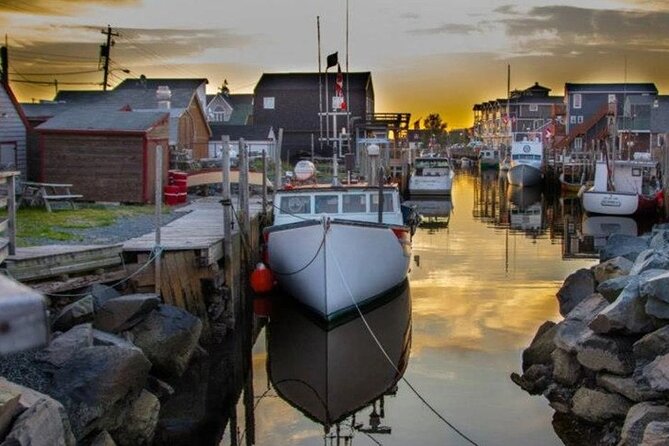
The final major stop is Fisherman’s Cove, a restored 200-year-old working fishing village with colorful buildings and plenty of photo opportunities. It is a welcome contrast to the cemeteries and memorials, and it gives you a look at the coastal character beyond downtown Halifax.
The van, timing, and value
The Ford Transit 350 XLT high-roof van is air-conditioned and equipped with WiFi and bottled water. Most of the tour is by vehicle, with selected walks at the Public Gardens, Citadel, cemeteries, memorials, lunch stop, and Fisherman’s Cove.
That makes the tour a good fit if you have limited walking ability. One person with a medical condition chose it specifically because it was mainly a driving tour with short walks and found it comfortable. Still, you should tell Paul your needs in advance, since the number and length of stops can vary with the group and the day’s schedule.
Cruise passengers need to be careful. If your ship leaves early, the full route may not be possible. One shortened outing returned a passenger to the Halifax area in time for the last tender, but the passenger then faced a roughly 1.8-kilometer walk back to the ship in rain. If you are sailing that afternoon, confirm exactly where you will be dropped off and when you must return.
The meeting point is Pier 22, 1041 Marginal Road. Cruise and driving visitors can park all day there for $10 CAD, with secure parking noted. Downtown hotel pickup is available, but not every hotel qualifies as downtown, so check before booking.
The tour requires at least four people and accepts no more than 10. If the minimum is not met, the operator offers another date or experience, or a full refund. You can cancel without penalty up to 24 hours before the start time. Lunch, gratuity, alcohol, and Citadel admission cost extra.
Should you book the Halifax Historical Tour?
Book it if you want one guide to connect Halifax’s major stories in a single day. Paul’s strongest qualities are his preparation, local detail, careful timing, and use of visual material. The route reaches places a large city coach may skip, including several cemeteries, the Explosion memorials, Dartmouth, and Fisherman’s Cove.
I would choose it early in a Halifax visit. The tour gives you a working map of the city and helps you decide where to return for more time, especially the Maritime Museum, Citadel, waterfront, and Public Gardens.
Skip it if your ideal day means slow museum visits, long walks, or unplanned wandering. Also think twice if your cruise schedule is tight. For everyone else, the 4.9 rating from 225 ratings and 99 percent recommendation fit the experience: it is a serious, personal, history-heavy tour with a lot of ground covered for the price.
FAQ
How long is the Halifax historical tour?
The tour lasts approximately six hours.
Where does the tour begin and end?
It begins at Pier 22, 1041 Marginal Road, Halifax, and ends back at the meeting point. Pickup is also offered from listed downtown hotels.
How many people can join the tour?
The tour requires a minimum of four people and accepts a maximum of 10 travelers.
Is lunch included?
No. Lunch is not included. The group stops at Evan’s Seafood in Dartmouth, where you can order fresh Nova Scotia seafood, including a gluten-free option.
Is admission to the Halifax Citadel included?
No. Admission to the Halifax Citadel National Historic Site is not included.
What is included in the tour price?
The price includes an air-conditioned vehicle, bottled water, and WiFi on board. Gratuity, alcohol, lunch, and Citadel admission are extra.
Just added around Halifax
- Zodiac Coastal Tour with Naturalist Guide: Lunenburg★ 5.0 · 105 reviews
- Private Tour in Halifax by a Luxury Vehicle with Informative Guide★ 5.0 · 92 reviews
- Wine Enthusiast Tour Lead by a Sommelier★ 4.5 · 6 reviews
- Winter Wine Escape★ 5.0 · 8 reviews
- Wine Tour Wolfville Wine Tours in Nova Scotia- 6 Hours★ 5.0 · 14 reviews
- Halifax Boardwalk & Seaport: a Smartphone Audio Walking Tour★ 4.0 · 19 reviews
- Peggy’s Cove Sunset tour★ 5.0 · 14 reviews
- JFarwell Sunset Wine & Cheese Aboard the Reverie★ 5.0 · 22 reviews
Historical Tours, compared.




Evening Gourmet Tour 5 Course Dinner – History and Food in Old Quebec City
Read our review →



Browse the lists this tour appears in