

Reviewed · KINGSTON TOURS
Ghost Tour of Queen’s University
Some old buildings keep their secrets.
Kingston’s Queen’s University Ghost Tour turns those secrets into a 75-minute evening walk through limestone buildings, churches, hospitals, and campus halls. I like the way it joins local history with ghost stories, and I like the small group limit of 20 people, which should make it easier to hear the guide. The main consideration is that this is an outdoor walking tour at 8 p.m., so weather and comfortable shoes matter.
The route has plenty of variety. You move from a courthouse and Gothic church to university buildings, an art museum, and the site of a former hospital. The stories can be enjoyed by adults, but the tour also appears suitable for children. One young participant especially enjoyed it, and the guide’s clear command of the stories helped make the evening a hit.
In This Review
- Key things to know before you book
- Why Queen’s University makes a good ghost-tour setting
- Starting at Kingston’s courthouse
- Chalmers United Church and its Gothic details
- Queen’s campus, where most of the tales unfold
- Fleming Hall and the story of Douglas Mill Jemmett
- Four Directions and the tragic story of Charles Sangster
- Summerhill and Queen’s early medical past
- Kingston’s hospitals and the empty new building
- The Agnes Etherington Art Centre after dark
- Dunning Hall and a newer campus mystery
- The John Deutsch University Centre and Alfie Pierce
- Price, timing, and group size
- Who should book this Queen’s ghost walk?
- Should you book the Ghost Tour of Queen’s University?
- FAQ
- Where does the Ghost Tour of Queen’s University begin?
- What time does the tour start?
- How long does the tour last?
- Where does the tour finish?
- How much does the tour cost?
- What language is the tour offered in?
- How many people can join the tour?
- Can I cancel for a full refund?
Key things to know before you book
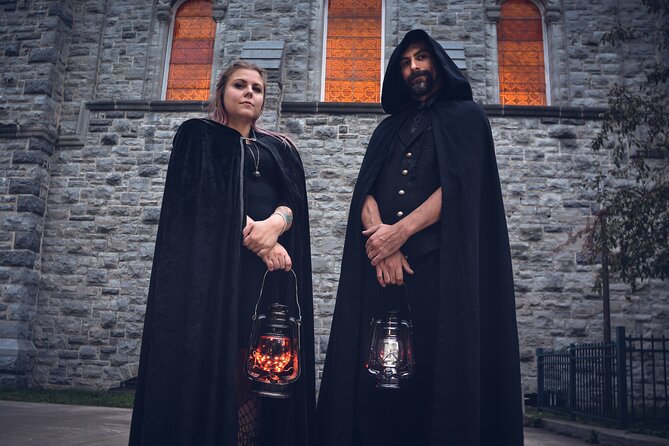
- The tour begins at the Kingston courthouse: The limestone building is a National Historic Site of Canada and provides the first setting for a ghost story.
- Queen’s University supplies most of the stories: The campus dates to the 1840s and includes old academic buildings, student spaces, and former medical facilities.
- Summerhill has an especially dark past: The former university building later housed the medical school, where some very macabre practices took place.
- The route includes several kinds of haunted places: Expect churches, hospitals, an art centre, lecture halls, and student buildings rather than one repeated type of stop.
- The group is capped at 20 people: That is a useful size for an evening storytelling walk.
- The price is $25.31 per person: For 1 hour and 15 minutes, the cost is reasonable if you enjoy local history as much as the supernatural side.
Why Queen’s University makes a good ghost-tour setting
Queen’s University is a natural backdrop for this kind of walk. Its campus reaches back to the 1840s, and many buildings have long connections with education, medicine, government, religion, and student life.
That mix gives the guide more to work with than simple tales of unexplained noises. The stories are tied to people and places, including a poet, an engineer, medical students, hospital patients, and a student union figure. I like that approach because even the less spooky sections can still teach you something about Kingston.
The setting also changes as you walk. You are not simply circling one dark building while waiting for the next scare. You begin at a civic landmark, pass a church, move through campus, and hear stories connected with buildings that still serve practical purposes today.
The tour begins at 8 p.m., when the old stone architecture should feel suitably atmospheric. The route ends back at the same meeting point, which keeps the evening simple. You do not need to arrange a separate ride from the final stop.
A few more Kingston trips worth comparing
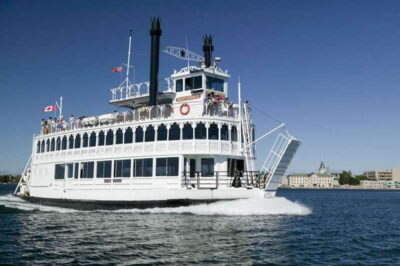
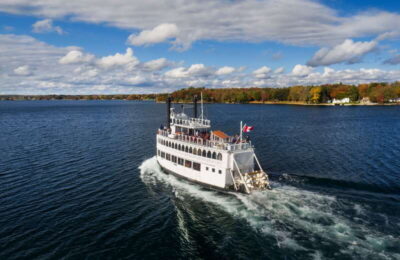
- Kingston: Heart of the Thousand Islands Riverboat Cruise
★ 4.2 · 771 reviews - Kingston: Lunch Cruise of Thousand Islands
★ 4.5 · 212 reviews - Kingston: Sunset Dinner Cruise
★ 4.5 · 197 reviews
Starting at Kingston’s courthouse
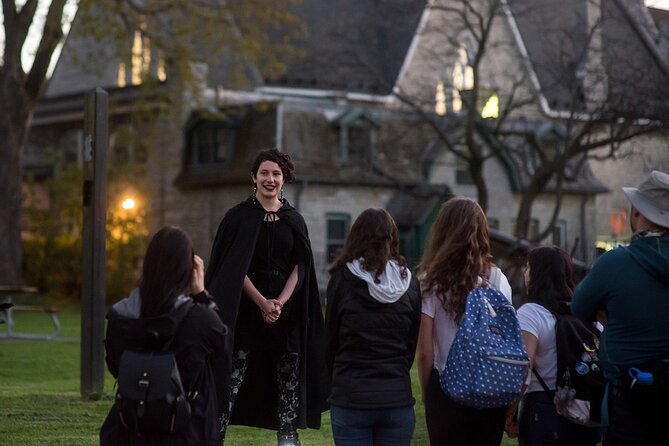
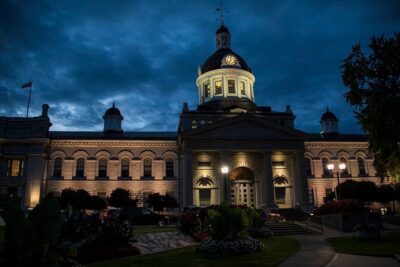
The meeting point is the Kingston, Frontenac County Courthouse at 5 Court Street. This imposing limestone building was built in the late 1850s in the Greek Revival style. Canada designated it a National Historic Site in 1980.
It is a strong opening location. The courthouse gives you an immediate sense of Kingston’s age and civic importance before the tour turns toward university life. The first ghost story is told here, so you get both architectural context and a supernatural tale right away.
I would arrive with enough time to find the building and prepare for the walk. The tour starts at 8 p.m., and a mobile ticket is accepted. The meeting point is near public transportation, which is useful if you are spending the evening in central Kingston without a car.
The courthouse stop is more about setting than spectacle. You should not expect an indoor investigation or special effects. This is a guided outdoor storytelling experience, with the building itself providing the mood.
Chalmers United Church and its Gothic details
The next notable stop is Chalmers United Church, built in 1890. Its Gothic Revival design gives the story a very different tone from the courthouse.
Churches are familiar settings for ghost tales, but this one is connected to a real heritage building and Kingston’s older streetscape. The guide shares a story about the church, giving you a reason to look closely at its architecture rather than simply pass by.
I appreciate this kind of stop because it breaks up the walk. The courthouse is formal and civic, while Chalmers feels more religious and intimate. The change helps keep the route from becoming a parade of similar limestone walls.
The church is also a reminder that the tour is about Kingston as much as Queen’s University. The university receives most of the storytelling time, but the opening section links the campus to the wider city.
Queen’s campus, where most of the tales unfold
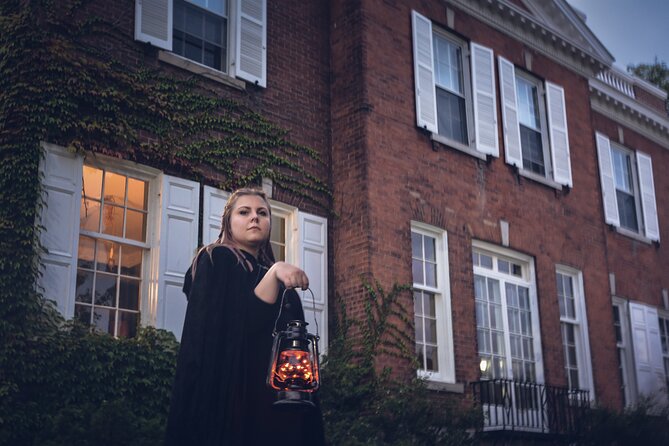
After the first city landmarks, the tour moves onto Queen’s University grounds. The campus dates back to the 1840s and combines historic buildings, green spaces, and newer facilities.
This is the heart of the walk. The guide shares most of the ghost stories here, and the campus offers a useful blend of academic life and old architecture. You may pass places that normally feel busy and practical in daylight, then hear about the strange events associated with them after dark.
The campus setting gives the stories a human scale. These are not only tales about anonymous spirits in abandoned ruins. The buildings have links to teachers, students, medical workers, engineers, artists, and administrators. That makes the stories easier to remember.
The route also appears well suited to people who prefer stories to theatrical scares. The guide’s role is central. A strong storyteller can make a lecture hall or student centre feel eerie without any props. The available feedback points to a guide who knew the building-related stories well and delivered them with real enthusiasm.
Still Kingston, at a slower pace:
- Kingston: Ghosts and Mysteries Trolley Tour
★ 4.4 · 158 reviews - Kingston: Haunted Night Walking Tour
★ 4.6 · 144 reviews - Kingston: Brunch Cruise of Thousand Islands
★ 4.3 · 132 reviews - Kingston: Waterfront Discovery Cruise
★ 4.2 · 129 reviews
Fleming Hall and the story of Douglas Mill Jemmett
Fleming Hall is one of the more layered stops. The original building honours Sir Sandford Fleming, a former chancellor of Queen’s. Its other wings honour people connected with electrical engineering, a subject taught there until 1989.
The Jemmett Wing is named for Douglas Mill Jemmett. His connection to one of the tour’s chilling stories gives the building a personal focus.
This is a good example of how the tour links names on campus buildings to actual people. You are not just hearing that a hall is haunted. You are given a reason to remember the name and the building.
Fleming Hall also shows how Queen’s has changed over time. A building can carry the names of university leaders and engineering figures while also serving as the setting for a disturbing tale. That contrast is part of the fun.
Four Directions and the tragic story of Charles Sangster
Four Directions moved into its current home in 2000. The building itself dates to 1886 and has housed several notable residents, including Canadian poet Charles Sangster.
The tour shares Sangster’s tragic story here. This stop adds a literary element that you will not find in the courthouse or engineering buildings. It also shows how old private or residential properties can become part of the university’s modern campus.
Four Directions was founded in 1996 to support the success of Indigenous students. That present-day purpose matters. The building is not presented only as an old haunted shell. It continues to serve the university community, which makes the contrast between its current role and its past residents more striking.
The Sangster story should appeal to you if you like ghost tours that connect folklore with biography. It is less about a generic apparition and more about a person whose life left a lasting mark on the place.
Summerhill and Queen’s early medical past
Summerhill may be the tour’s most historically loaded stop. Built in 1839, it was first intended as the country villa of Archdeacon George O’Kill Stuart.
When Kingston served for a time as Canada’s capital, Summerhill became a boarding house for members of the Legislative Assembly. Queen’s purchased it in 1854, and for many years it was the university’s only building.
That alone would make Summerhill worth seeing. Its later use adds the darker edge. The building housed the medical school, which used it for very macabre practices. The tour draws on that unsettling period for its ghost story.
I find this kind of story more effective than a simple tale of a mysterious figure. Medical education involved practices that can sound disturbing even now, and the old building provides a direct link to that past. You get a lesson in university development, Canadian government, and early medicine in one stop.
Summerhill is also a useful reminder to keep an open mind about the tour’s tone. Some stories may feel spooky, while others are unsettling because they describe real events and outdated medical methods.
Kingston’s hospitals and the empty new building
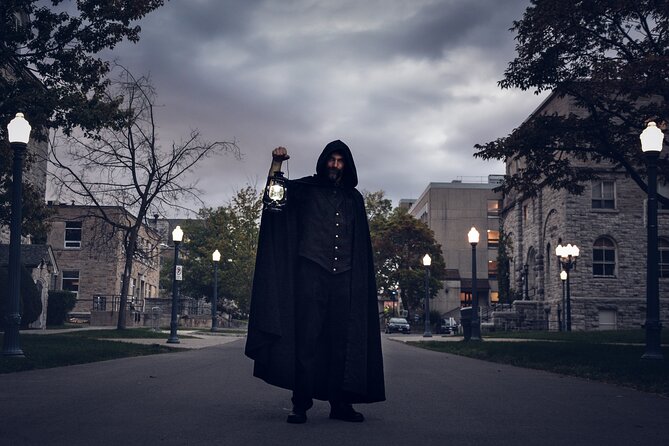
Kingston has several hospitals connected with medical training at Queen’s. Kingston General Hospital was built in 1835, but the original building sat empty for three years after completion because there was no money left for furnishings.
That detail gives the hospital section an unusual twist. An impressive new building without beds, equipment, or furniture is already an eerie image, even before the ghost stories begin.
The hospital also served several purposes over time, including use as Canada’s first temporary parliament building. The tour shares stories from two Kingston hospitals, widening the focus beyond the university campus.
This part should appeal to you if you enjoy history with your supernatural storytelling. Hospitals carry natural emotional weight, but the guide also places them within Kingston’s political and medical past.
Do keep expectations sensible. The tour does not promise entry into hospital interiors or a paranormal investigation. The value comes from hearing the stories in relation to the buildings and institutions around you.
The Agnes Etherington Art Centre after dark
The Agnes Etherington Art Centre is one of Queen’s University’s major cultural spaces. Its collection includes more than 17,000 works of art, ranging from ancient pieces to contemporary work.
It is also one of the tour’s haunted locations. That makes this stop a pleasant change from the medical and academic stories. An art museum carries a different kind of atmosphere, with objects, galleries, and quiet spaces that can take on a new character after dark.
The centre offers exhibitions, programs, architecture, and outdoor areas during normal visits. On this tour, you are there for the ghost story rather than a museum visit, so do not assume the route includes time to view the collection.
Still, the art centre adds welcome variety. I like that the tour does not limit itself to buildings that look spooky from the outside. A working museum can be just as effective a setting for a strange story as a church or hospital.
Dunning Hall and a newer campus mystery
Dunning Hall was built in 1960 and houses Queen’s Department of Economics. Compared with the older university buildings, it is a much newer stop, with large lecture halls and modern stone construction.
Its inclusion is important because it shows that the tour is not claiming only very old places can be haunted. Dunning Hall represents the modern university, yet it has one of the lesser-known campus haunts.
The story here may appeal most to repeat visitors or anyone who likes less familiar locations. You get a break from the expected Gothic church and nineteenth-century villa. The building is fairly plain by comparison, which places more weight on the guide’s storytelling.
That variety is one of the route’s strengths. If every stop had an ornate façade, the walk would look beautiful but feel repetitive. Dunning Hall changes the rhythm.
The John Deutsch University Centre and Alfie Pierce
The final major campus setting is the John Deutsch University Centre. The original student union building was destroyed by fire, and the current centre was rebuilt in 1947.
Most ghostly events connected with the spirit of Alfie Pierce are said to take place here. The student centre gives the tour a fitting campus finale because it connects the supernatural stories to student life and university community.
After churches, hospitals, lecture halls, and old residences, this stop feels more social. You can see how the tour moves through different parts of Queen’s rather than treating the university as a single old-fashioned complex.
The tour ends back at the courthouse meeting point. That return is practical, especially at night, and gives the route a clear beginning and finish.
Price, timing, and group size
At $25.31 per person, the tour is fairly priced for a guided experience lasting about 1 hour and 15 minutes. You are paying for a local guide, a carefully arranged route, and stories tied to specific Kingston buildings rather than a generic ghost walk.
The value improves if you enjoy both history and folklore. If you want jump scares, actors, or elaborate effects, you may find the price less convincing. This is a walking and storytelling tour, not a haunted-house attraction.
The maximum group size is 20 people. That is small enough for the guide’s voice and stories to remain the focus, while still large enough to give the evening a social feel.
The experience is offered in English and uses a mobile ticket. Service animals are allowed, and most people can participate. Because it requires good weather, you should check the forecast and bring suitable clothing. If poor weather cancels the tour, you are offered another date or a full refund.
You can cancel for a full refund up to 24 hours before the start time. A minimum number of participants is also required, so a cancellation for that reason brings the choice of another date or experience, or a full refund.
Who should book this Queen’s ghost walk?
I would recommend it to you if you enjoy:
- Local stories tied to real buildings
- University and Canadian history
- Evening walks with a spooky mood
- Small-group guided experiences
- Family activities that do not depend on extreme scares
- Seeing Kingston landmarks from a different angle
The tour appears suitable for children, but the medical and hospital stories may not suit every young child. Use your judgment, especially if your child is sensitive to tales involving death or disturbing medical practices.
It is also a good choice for a last-minute evening plan, although the experience is booked about 10 days ahead on average. If your schedule is fixed, booking earlier is sensible.
You should think twice if you dislike outdoor walks, need a daytime activity, or want substantial time inside the buildings. The route focuses on exterior settings and guided stories. The exact level of fright will depend heavily on the guide and your own imagination.
Should you book the Ghost Tour of Queen’s University?
Yes, if you want an affordable Kingston evening that blends campus history with ghost stories. The best parts are the range of settings, the real people behind several tales, and the way Queen’s University connects education, medicine, government, art, and student life.
I especially like the contrast between Summerhill’s early medical use, the hospitals’ political past, the art centre’s unexpected haunting, and Alfie Pierce’s connection with the student centre. Those details give the walk more substance than a simple list of spooky buildings.
Book it if you value storytelling and atmosphere over theatrical scares. Wear comfortable shoes, dress for the weather, arrive at the courthouse before 8 p.m., and expect to spend the evening outdoors. At $25.31, it is a sensible pick for families, history fans, and anyone looking for a different way to see Queen’s University after dark.
FAQ
Where does the Ghost Tour of Queen’s University begin?
The tour begins at the Kingston, Frontenac County Courthouse, located at 5 Court Street, Kingston, Ontario.
What time does the tour start?
The start time is 8 p.m.
How long does the tour last?
The experience lasts approximately 1 hour and 15 minutes.
Where does the tour finish?
The tour ends back at the courthouse meeting point.
How much does the tour cost?
The listed price is $25.31 per person.
What language is the tour offered in?
The tour is offered in English.
How many people can join the tour?
The maximum group size is 20 people.
Can I cancel for a full refund?
Yes. You can cancel at least 24 hours before the start time for a full refund. If poor weather cancels the experience, you are offered another date or a full refund.
Just added around Kingston
- Trolley City Tour of Kingston★ 5.0 · 27 reviews
- Orignal Haunted Walk of Kingston 75-Minute Ghost Tour★ 4.5 · 113 reviews
- Kingston Self-Guided Walking Tour & Scavenger hunt (updated)★ 3.5 · 10 reviews
- Heart of the 1000 Islands Sightseeing Cruise★ 4.0 · 80 reviews
- Kingston Bike Tours★ 5.0 · 30 reviews
- Kingston: Waterfront Shipwreck Cruise with Guide★ 3.9 · 14 reviews
- Kingston: Hop-On Hop-Off Trolley Tour★ 4.7 · 57 reviews
- Kingston: Trolley City Tour★ 4.6 · 99 reviews
Kingston Tours, compared.
Kingston: Heart of the Thousand Islands Riverboat Cruise
Read our review →

Orignal Haunted Walk of Kingston 75-Minute Ghost Tour
Read our review →Browse the lists this tour appears in